Key takeaways
- Compare the best mechanic stools for garage work, from a 400 lb Traxion gear seat to compact tray stools, with capacity, caster and height checks.
A floor jack gets the car up and stands keep it there, but the brake job, wheel swap or detailing session that follows is mostly seated work. A good mechanic stool puts you at sill height, rolls with you along the side of the car, and keeps sockets and fasteners off the floor. This guide covers rolling seats and stools only, not flat creepers for sliding under a vehicle.
As an Amazon Associate, we earn from qualifying purchases.
The five stools below split into clear camps: a heavy-duty gear seat with oversized casters, two pneumatic stools that adjust in height, a drawer-equipped work seat for detailers, a compact fixed tray stool, and a convertible design that folds out into a creeper when a job calls for it.
Quick answer
For most home garages, the WEN 73012T is the easiest mechanic stool to live with: pneumatic height adjustment, a 300 pound capacity and a tool tray under the seat. Bigger mechanics should look at the Traxion 2-701 and its 400 pound rating, while the Torin TR6300 suits tight budgets and small bays.
Traxion 2-701 ProGear Mobile Rolling Gear Seat

The Traxion 2-701 ProGear is the heavy-duty pick of this group, rated to support up to 400 pounds, the highest capacity here. It is built around a racing-style contoured seat with a backrest, so long brake and suspension jobs are easier on your lower back than a flat pad. Five 5-inch casters carry the seat, and that wheel diameter is the real story: the big casters roll over air hoses, extension cords, floor cracks and creeper boards that stop smaller wheels cold. Seat height adjusts from 13.5 to 17.5 inches through the ProGear drop-sleeve design, a range that lines up well with wheel, brake and rocker-panel work. Under the seat sits the signature gear tray, which spins on its own axis so sockets, lug nuts and trim clips stay within reach as you rotate around the car. A carry handle is molded into the seat, which helps because at 21 pounds this is not a stool you move absent-mindedly. The footprint is roughly 22 by 22 inches, the largest here, so it needs a bay with room to maneuver. There is no backrest-free low mode and the casters do not lock, so park it on level concrete. For larger mechanics and rough shop floors, nothing else in this roundup is as well matched.
WEN 73012T Pneumatic Rolling Mechanic Stool

The WEN 73012T is the adjustable all-rounder. Its pneumatic lifting pole raises and lowers the round seat through a 15 to 20 inch height range with a lever, so the same stool works for low brake jobs and higher bench-side tasks. The rated capacity is 300 pounds, evenly distributed, which covers most users with a sensible margin. Five 2.5-inch casters carry the base, and a tool tray sits under the seat for the handful of sockets and drivers a single job needs. The seat itself is multilayered padding protected by a vinyl cover, a practical choice in a garage where brake cleaner and oil are part of the day. Assembly is about as simple as this class gets: the base, the lifting pole and the seat press together in three pieces. At 12.5 pounds it is easy to carry between bays or hang out of the way. The trade-offs are the small casters, which will catch on wide expansion joints and rough driveway concrete, and the backless round seat, which offers no support on marathon sessions. The overall footprint is about 20 by 15 inches per the manual, compact enough for a single-car garage where floor space is contested.
Powerbuilt Rolling Work Seat, 941881ECE

The Powerbuilt 941881ECE is the storage-first option, aimed at brake work and detailing where you carry a small arsenal with you. The listing rates it at 330 pounds of capacity, second highest here, and it rolls on 4-inch rubber wheels that lock, so the seat stays planted when you lean into a caliper bolt or a polishing pass. The seating platform is large and thickly padded, with a backrest for support during long seated sessions. What sets it apart is the furniture underneath: two sliding storage drawers, tool trays and can holders are built into the base, so pads, brushes, spray bottles and hardware travel with the seat instead of migrating across the floor. That makes it a natural fit for detailers who work panel by panel and for anyone whose garage lacks a bench within reach of the car. The compromises follow from the design. It is the bulkiest footprint in this group, the drawers add width in tight bays, and the listing does not offer pneumatic height adjustment, so you sit at the height the platform gives you. If your work is mostly seated, stationary and supply-heavy, that trade is usually worth it.
BIG RED Torin TR6300 Rolling Creeper Seat
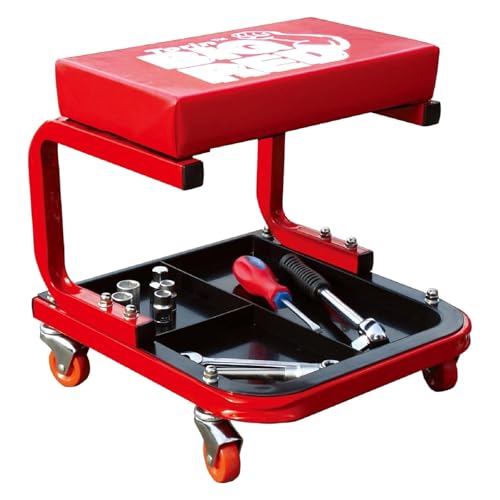
The Torin TR6300, sold under the BIG RED label, is the simple compact stool of the group. A heavy-duty tubular steel frame carries a fully padded rectangular seat, and a large segmented tool tray underneath keeps wrenches and fasteners sorted while you scoot along the side of the car. Four 360-degree swivel casters handle movement, and the whole unit weighs only 9 pounds, so it is the easiest here to pick up, hang on a wall hook or toss in a corner. It arrives with no assembly required, and Torin backs it with a limited one-year manufacturer warranty. The maximum weight recommendation is 250 pounds, the lowest rating in this roundup, and the seat height is fixed at just over 14 inches, which suits wheel and brake work but not taller bench tasks. The overall footprint is about 14.4 inches square, small enough for crowded two-car garages where a bigger gear seat would constantly clip tires and jack handles. The small casters prefer smooth, swept concrete and will grumble over cracks and debris. For a first rolling seat, or a second stool that lives by the tire rack, the TR6300 covers the basics without wasted size or features.
Pro-LifT C-2036D Z-Creeper Seat

The Pro-LifT C-2036D answers a different question: what if one piece of gear could be both the seat and the occasional creeper? Its Z-frame folds flat into a 36-inch creeper for sliding under a vehicle, then locks upright with a retractable pin to become a rolling seat for brake, wheel and detailing work. The alloy steel frame is rated for 300 pounds, and thick padded cushions cover both the seat section and the headrest area used in creeper mode. Six swivel casters carry the frame, more contact points than any other pick here, which helps it track straight in creeper mode. Included components are the caster assembly, a hardware kit and the seat, so some assembly is part of the deal, and at 18 pounds it is heavier than a plain stool. In seat mode the height is fixed by the frame geometry, with no pneumatic adjustment, and dedicated flat creepers still glide lower for long underbody sessions. Treat the C-2036D as a seat first that moonlights as a creeper for quick inspections and oil changes, and it makes strong sense for a one-car garage where storing two separate rollers is not realistic.
How to choose
Start with capacity, and leave a margin: pick a stool rated comfortably above your body weight plus whatever you lean against it, since side loads during brake work are not gentle. Next, match caster size to your floor. Wheels of 4 to 5 inches roll over cords, hoses and expansion joints; 2.5-inch casters are fine on smooth, swept concrete and frustrating everywhere else. Seat height decides which jobs feel natural. Fixed seats around 14 inches and adjustable ranges starting near 13.5 inches suit wheels and brakes, while a pneumatic stool that reaches 20 inches doubles as bench seating. Storage is the fourth call: a simple tray suits socket work, a spinning gear tray keeps fasteners orbiting with you, and drawers earn their bulk only if you detail or carry many small supplies. Finally, inspect the lift hardware before you buy and after it arrives. In January 2025, the CPSC and Health Canada recalled Northern Tool adjustable swivel shop stools with backrests, model 20230, made by Intradin, because the seat could detach from its hydraulic cylinder and cause falls. None of the five stools in this guide is that model, but the recall is a reminder to check the cylinder collar and seat mount on any pneumatic stool, and to search the CPSC database before buying a used one.
Who should skip
Skip a rolling stool entirely if most of your work is under the car; a flat creeper or a lift is the right tool there, and a seat only gets in the way. Skip the high-capacity and drawer-equipped models if your garage floor is gravel, dirt or broken concrete, because no caster in this class rolls on that. Anyone close to a stool’s weight rating should step up a class rather than ride at the limit, and detailers who stand to polish roofs and hoods will get more from a platform step than from any seat here.
Frequently asked questions
What seat height works best for brake and wheel work?
A seat that puts your hips a little below the wheel center works best, which for most people means a sitting height between about 13 and 18 inches. Fixed stools near 14 inches are fine for average-height users, but taller or shorter mechanics benefit from a pneumatic stool with a 15 to 20 inch range, since it can drop for brakes and rise for bench-side tasks.
How much weight capacity should a mechanic stool have?
Choose a rating with real headroom over your body weight, because you lean, twist and brace against the seat while working, which loads it unevenly. A 250 pound stool suits lighter users doing occasional jobs, 300 pounds covers most home mechanics, and anyone near those numbers, or who simply wants the sturdiest frame, should look at the 330 and 400 pound options.
Are bigger casters worth it on a rolling seat?
On anything other than perfect concrete, yes. Small 2.5-inch casters stop at expansion joints, zip ties and air hoses, and each stop pitches you forward. Casters of 4 to 5 inches roll over those obstacles and track straighter when you push off with your feet. The trade-off is size: big-caster seats have wider footprints and need more room between the car and the wall.
Can a mechanic stool replace a creeper?
Not fully. A stool covers seated work at wheel, brake and sill height, while a creeper puts you flat and low under the vehicle, and the two overlap very little. A convertible seat like the Pro-LifT C-2036D bridges the gap for quick underbody checks and oil changes, but for long sessions under a car, a dedicated creeper with a proper headrest is still more comfortable.
Final verdict
Most home garages should start with the WEN 73012T: it adjusts to the job, carries 300 pounds and keeps a tray of tools under the seat. Larger mechanics and rough floors point to the Traxion 2-701, detailers to the drawer-equipped Powerbuilt, tight bays to the Torin TR6300, and anyone short on storage to the convertible Pro-LifT C-2036D.
Product and ASIN Reference
| Product | ASIN |
|---|---|
| Traxion 2-701 ProGear Mobile Rolling Gear Seat | B0CY2WVSQ6 |
| WEN 73012T Pneumatic Rolling Mechanic Stool | B08ZWDP7SC |
| Powerbuilt Rolling Work Seat, 941881ECE | B0B831SMJ3 |
| BIG RED Torin TR6300 Rolling Creeper Seat | B000COC67E |
| Pro-LifT C-2036D Z-Creeper Seat | B00826OVWW |
More from Amazon
Programs that pair well with the guide above. Offers and eligibility are set by Amazon and may change.
Free shipping on eligible items, Prime Video and more. Eligible new members can start with a free trial.
Start a Prime free trialAudiobooks and podcasts to listen to on the go. Eligible new members can start with a free trial.
Try Audible freeAd-free music streaming. Eligible new subscribers can start with a free trial.
Try Music Unlimited freeA free business account with business pricing and bulk-buying tools for work, shop or home office.
Create a business accountAs an Amazon Associate we earn from qualifying purchases.