Key takeaways
- Find the best rc car metal gear servos for your scale, with four picks covering 1/8 trucks, 1/10 steering, 1/12 on-road cars and 1/24 crawlers compared.
A stripped servo gear is one of the fastest ways to end a run early. Plastic and hybrid gear trains are fine for light duty, but once a car gets heavier, the tires get grippier, or the steering starts taking hits from jumps and rock crawling, the gear train becomes the weak point. That is why so many drivers searching for the best rc car metal gear servos are really asking a simpler question: which servo survives the abuse my car actually dishes out, without giving up speed or precision?

This guide compares four metal gear servos that cover very different corners of the hobby. There is a standard-size all-rounder for 1/10 cars, a high-voltage brushless unit built for 1/8 trucks and direct 4S power, a fast titanium-gear mini servo for 1/12 on-road racing, and a compact micro servo made for 1/18 and 1/24 crawlers. Each one uses a full metal gear train, but they differ in size class, torque delivery, motor type, and waterproofing, so the right choice depends far more on your car and your power system than on any single headline number.
Quick Picks
Our Short List of 3
- Best for: 1/10 steering upgrades and mixed RC or robotic projects where one servo needs to work across several voltage setups.
- ASIN: B07S9XZYN2
- Stall torque: 29 kg-cm at 5.0V, 32 kg-cm at 6.0V, 35 kg-cm at 7.4V
- Speed: 0.13 / 0.12 / 0.11 sec per 60 degrees at 5.0 / 6.0 / 7.4V
- Operating voltage: 5–7.4V
- Best for: 1/8 trucks and heavy 1/10 builds, especially high-voltage setups that can feed it 16.8V directly from a 4S pack.
- ASIN: B0BZ75LHN6
- Torque class: 62 kg
- Motor: brushless
- Gears: reinforced steel, full metal gear train

- Best for: 1/18 and 1/24 crawler owners who want metal-gear durability and real steering torque in a micro footprint.
- ASIN: B0BTBR93YZ
- Maximum torque: 11 kg-cm at 8.4V (9.5 kg-cm at 7.4V, 8 kg-cm at 6.0V)
- Speed: 0.106 sec per 60 degrees at 6.0V, down to 0.074 sec at 8.4V
- Operating voltage: 6–8.4V
All 3 Picks at a Glance
| Product | Specs | Action |
|---|---|---|
| ZOSKAY DS3235 35KG Coreless Servo |
| Check price on Amazon |
| AGFRC A75BUMW 62KG Brushless Servo |
| Check price on Amazon |
| INJORA INJS11 11KG Micro Servo |
| Check price on Amazon |
How to Choose
Match the Case Size to Your Scale First
Servos are not interchangeable across scales. A standard-size servo measures roughly 40 × 20 mm at the mounting face and fits 1/10 and 1/8 cars. A mini servo is noticeably shorter and narrower, and a micro servo smaller still, and each size class has its own mounting pattern and horn geometry. Buying a powerful servo that physically does not fit your chassis is the most common mistake in this category, so confirm your car’s servo dimensions before comparing any other spec. In this guide, the ZOSKAY DS3235 and AGFRC A75BUMW are standard size, the AGFRC B26CLM V2 is a mini, and the INJORA INJS11 is a micro for small crawlers.
Read Torque and Speed Together, at Your Voltage
Torque figures only mean something alongside the voltage they were measured at. The same servo produces meaningfully different torque at 6.0V than at 8.4V, which is why the listings here quote several voltages. Speed, quoted in seconds per 60 degrees of travel, pulls in the opposite direction: very high-torque servos tend to be slower, while racing servos trade torque for response. A crawler driver usually wants torque above all, because the wheels are often wedged against rock. A 1/12 on-road driver wants the opposite balance, since the car is light and steering inputs need to be immediate.
Gear Material and Motor Type Decide Longevity
All four servos here use metal gears, but the metals differ. Stainless steel gears are tough and corrosion resistant, titanium gears are light and very hard, and reinforced steel gear sets are built for maximum load in big cars. The motor matters too. Coreless motors respond quickly and run smoothly at low speed, which helps steering feel. Brushless motors, like the one in the A75BUMW, remove brush wear from the equation entirely and suit high-voltage, high-load use. Dual ball bearings on the output shaft are worth looking for in every class, because they keep the gear mesh aligned under side loads.
Check Voltage Range, BEC Demands, and Waterproofing
A servo can only deliver its rated performance if your electronics can feed it. High-voltage servos need a BEC or receiver setup that actually outputs the voltage they are rated for, and the A75BUMW goes further by running directly on a 4S LiPo at 16.8V with no BEC in between. Waterproofing also varies: an IP67 rating means the unit is sealed against immersion, while a water-resistant design with an O-ring seal shrugs off splashes and wet trails but is not the same guarantee. Match the sealing to how wet your running actually gets.
The Servos
ZOSKAY DS3235 35KG Coreless Servo
- Best for: 1/10 steering upgrades and mixed RC or robotic projects where one servo needs to work across several voltage setups.
- ASIN: B07S9XZYN2
- Stall torque: 29 kg-cm at 5.0V, 32 kg-cm at 6.0V, 35 kg-cm at 7.4V
- Speed: 0.13 / 0.12 / 0.11 sec per 60 degrees at 5.0 / 6.0 / 7.4V
- Operating voltage: 5–7.4V
1/10 steering upgrades and mixed RC or robotic projects where one servo needs to work across several voltage setups.
The 270-degree travel is more than a steering rack can use, so set your endpoints carefully; torque is strong for its class but it is not a substitute for a dedicated 1/8 high-voltage unit.
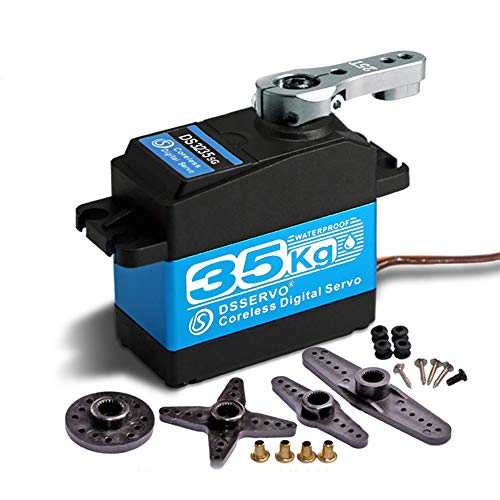
The DS3235 is the straightforward upgrade pick for a standard-size slot. It is a digital coreless servo with stainless steel gears, a CNC aluminium middle shell, and dual ball bearings, and it works across a wide 5–7.4V operating range, so it drops into everything from a basic 6V receiver setup to a 7.4V high-voltage system without drama. Stall torque climbs from 29 kg-cm at 5.0V to 35 kg-cm at 7.4V, while speed improves from 0.13 to 0.11 seconds per 60 degrees over the same range.
This particular version has a 270-degree control angle, which is worth knowing before you order. That wider travel suits robotic and DIY projects as much as steering duty, and for a normal car installation you will simply use the middle of the range. The package includes a 25T adjustable metal servo arm, and the design is described as waterproof, which makes it a sensible fit for trail trucks and bashers that see puddles and dust.
Watch out for: The 270-degree travel is more than a steering rack can use, so set your endpoints carefully; torque is strong for its class but it is not a substitute for a dedicated 1/8 high-voltage unit.
AGFRC A75BUMW 62KG Brushless Servo
- Best for: 1/8 trucks and heavy 1/10 builds, especially high-voltage setups that can feed it 16.8V directly from a 4S pack.
- ASIN: B0BZ75LHN6
- Torque class: 62 kg
- Motor: brushless
- Gears: reinforced steel, full metal gear train
1/8 trucks and heavy 1/10 builds, especially high-voltage setups that can feed it 16.8V directly from a 4S pack.
The headline torque assumes the high-voltage supply; on a lower-voltage system you will not see the full performance, and the programmer needed to adjust its parameters is a separate purchase.
The A75BUMW is the heavy hitter of this group. It is a standard-size brushless digital servo in the 62 kg torque class, with reinforced steel gears throughout, double ball bearings, and a 25T horn spline. AGFRC builds it for 1/10 and 1/8 on-road and off-road cars, monster trucks, and crawlers, which tells you the intended workload: big tires, heavy chassis, and steering loads that would overwhelm an ordinary servo.
Its defining feature is the 16.8V high-voltage design. The servo can run directly from a 4S LiPo with no BEC stepping the voltage down, which simplifies wiring in high-power builds and lets the motor work at the voltage it was designed for. It is also programmable through the AGFRC programmer, though that tool is not included in the box. Sealing is rated IP67 with a magnetic sensor arrangement, so wet running is firmly on the table. The control angle is 180 degrees.
Watch out for: The headline torque assumes the high-voltage supply; on a lower-voltage system you will not see the full performance, and the programmer needed to adjust its parameters is a separate purchase.
AGFRC B26CLM V2 10.5KG Titanium Gear Mini Servo
The B26CLM V2 is built for a completely different job: speed in a small car. It is a mini-size digital servo aimed at 1/12 on-road and off-road cars, delivering 10.5 kg of torque with a fast 0.08-second transit speed. For a light pan car or 1/12 scale racer, that response time matters more than raw pulling power, and the coreless motor helps it change direction cleanly.
The gear train is titanium, which keeps rotating mass low while staying hard-wearing, and the aluminum middle shell and dual ball bearings round out a construction that is closer to a racing component than a budget upgrade. It is also programmable, with adjustable torque, speed, angle, and inversion through the AGFRC programmer, again sold separately. The control angle is 180 degrees plus or minus 10, and the horn spline is 25T at 5.92 mm.
Specs
- ASIN: B08396F3J3
- Torque: 10.5 kg
- Speed: 0.08 sec
- Motor: coreless
- Gears: titanium
- Case: aluminum middle shell
- Bearings: dual ball bearings
- Programmable: torque, speed, angle, and inversion via AGFRC programmer (not included)
- Control angle: 180 degrees ±10
- Size: 35.8 × 15.2 × 29.7 mm (mini)
- Horn spline: 25T (5.92 mm)
- Intended use: 1/12 on-road and off-road RC cars
Best for: 1/12 racers who want fast, precise steering and the option to tune servo behavior for different track surfaces.
Watch out for: The mini case only fits cars designed for mini servos, and 10.5 kg of torque is not enough for heavy 1/10 trucks; this is a precision tool for light cars, not a basher upgrade.
INJORA INJS11 11KG Micro Servo
- Best for: 1/18 and 1/24 crawler owners who want metal-gear durability and real steering torque in a micro footprint.
- ASIN: B0BTBR93YZ
- Maximum torque: 11 kg-cm at 8.4V (9.5 kg-cm at 7.4V, 8 kg-cm at 6.0V)
- Speed: 0.106 sec per 60 degrees at 6.0V, down to 0.074 sec at 8.4V
- Operating voltage: 6–8.4V
1/18 and 1/24 crawler owners who want metal-gear durability and real steering torque in a micro footprint.
It does not fit the original TRX4M or SCX24 mount bracket and horn per the listing, so budget for compatible mounting hardware; full torque also needs an 8.4V supply.
Small-scale crawlers put their steering servos through a surprising amount of work, because the wheels are constantly wedged against rocks at full lock. The INJS11 is INJORA’s answer for 1/18 and 1/24 crawlers: a micro-size digital servo with a coreless motor, stainless steel gears, and a CNC machined aluminum case, weighing just 21 g. Maximum torque is 11 kg-cm at 8.4V, stepping down to 9.5 kg-cm at 7.4V and 8 kg-cm at 6.0V, and speed ranges from 0.106 seconds per 60 degrees at 6.0V to 0.074 seconds at 8.4V.
Practical details suit the crawler niche. The case is water resistant with an O-ring seal for wet trails, the wire exits from the side to help with tight chassis layouts, and the output rides on dual ball bearings with a 25T spline. One fitment warning matters: the listing states this servo is not compatible with the original TRX4M and SCX24 mount bracket and servo horn, so many owners will need the matching INJORA mounting hardware rather than the stock parts.
Watch out for: It does not fit the original TRX4M or SCX24 mount bracket and horn per the listing, so budget for compatible mounting hardware; full torque also needs an 8.4V supply.
Which One Fits Your Situation
If you run a typical 1/10 basher, trail truck, or touring car on a standard receiver setup, the ZOSKAY DS3235 is the easy recommendation. Its wide voltage range means it works with the electronics you already have, the stainless gear train removes the stripped-gear worry, and the included metal arm completes the upgrade in one box.
If your car is a 1/8 truck or a heavy monster truck, go straight to the AGFRC A75BUMW. Nothing else in this group is built for that load class, and if your build already runs 4S power, the direct 16.8V operation turns the servo into one of the simplest parts of the wiring rather than another BEC calculation.
If you race 1/12 on-road, the AGFRC B26CLM V2 is the only pick here that fits your car and your priorities. Its value is in response speed and tunability, not torque, and the titanium gears keep it durable without slowing it down.
If you crawl at 1/18 or 1/24 scale, the INJORA INJS11 is the one designed for you. Just confirm your mount and horn situation first, because the stock bracket on the most popular mini crawlers is not a direct fit.
Common Mistakes
Buying by torque alone. A huge torque number measured at a voltage your car cannot supply is meaningless. Always compare torque figures at the voltage your BEC or receiver actually delivers, and remember that crawlers and racers need opposite ends of the torque-speed balance.
Ignoring case size and spline count. Standard, mini, and micro servos have different mounting footprints, and horns are not universal either. Three of the servos here use a 25T spline, but the horn still has to match your steering linkage, and the INJS11 needs specific mounting hardware on popular mini crawlers.
Skipping endpoint setup. A metal gear servo is strong enough to damage linkages, servo savers, and itself if it keeps pushing past the steering’s mechanical limits. Set your travel endpoints on the transmitter or ESC after installation, especially with wide-angle units like the 270-degree DS3235 version.
Assuming waterproof means maintenance-free. IP67 sealing and O-ring seals protect the electronics, but bearings, horns, and gear grease still live a hard life in wet conditions. Rinse off mud, dry the car, and check the output shaft for play after wet runs.
FAQ
Are metal gear servos always better than plastic gear servos?
For steering duty in cars that jump, crawl, or run heavy tires, yes, metal gears are the safer choice because they tolerate shock loads that chip plastic teeth. Plastic gears can be quieter and are fine in light, low-load applications, but every servo in this guide uses a metal gear train because durability is the point of the category.
How much torque does an RC car steering servo actually need?
It depends on scale and tire grip. A light 1/12 racer is well served by the 10.5 kg class of the B26CLM V2, a 1/10 car is comfortable in the 29–35 kg-cm range of the DS3235 at its rated voltages, and a heavy 1/8 truck justifies a 62 kg class unit like the A75BUMW. Small crawlers sit in between in effort terms, which is why the INJS11’s 11 kg-cm at 8.4V is meaningful in a micro case.
What does control angle mean, and does 270 degrees matter for a car?
Control angle is the total travel the servo can sweep. Cars use a fraction of it, so a 180-degree servo is more than enough, and the 270-degree DS3235 version simply has extra range that suits robotics; in a car you limit travel with endpoints. What matters is that the servo centers accurately and uses its middle range smoothly.
Do I need a programmer for the AGFRC servos?
No. Both AGFRC servos here work out of the box with default settings. The programmer, sold separately, only matters if you want to adjust parameters such as torque, speed, angle, or inversion on the B26CLM V2, or fine-tune the A75BUMW’s behavior for a specific build.
Related Guides
- How to set steering endpoints and servo savers on 1/10 trucks
- BEC basics: choosing the right voltage for high-torque servos
- Mini crawler upgrades: mounts, horns, and steering links for 1/18 and 1/24 rigs
As an Amazon Associate, we earn from qualifying purchases.
More from Amazon
Programs that pair well with the guide above. Offers and eligibility are set by Amazon and may change.
Free shipping on eligible items, Prime Video and more. Eligible new members can start with a free trial.
Start a Prime free trialAudiobooks and podcasts to listen to on the go. Eligible new members can start with a free trial.
Try Audible freeAd-free music streaming. Eligible new subscribers can start with a free trial.
Try Music Unlimited freeA free business account with business pricing and bulk-buying tools for work, shop or home office.
Create a business accountAs an Amazon Associate we earn from qualifying purchases.