Key takeaways
- Compare the best car scratch removers for light clear coat scratches, swirl marks, and scuffs, with compounds, kits, and tips for safe hand application.
Light scratches are the most common paint defect on daily-driven cars. Shopping cart scuffs, brush marks from automatic washes, fingernail scratches behind door handles, and swirl marks from rough towels all sit in the clear coat, and most of them can be leveled with the right remover. The key is matching the product to the defect: a fine scratch remover handles haze and shallow marks, while a stronger compound is needed for visible scratches and dull, oxidized patches. This guide compares five proven options, from a gentle all-rounder to a drill-powered kit, and explains how to tell whether a scratch is a candidate for a remover at all.
As an Amazon Associate, we earn from qualifying purchases.
Quick answer
For most light clear coat scratches, Meguiar’s ScratchX is the safest starting point thanks to its controlled cut and easy hand application. Turtle Wax Scratch Repair and Renew suits shallow scuffs, the Meguiar’s Quik Scratch Eraser Kit adds drill power for isolated marks, Meguiar’s Ultimate Compound handles heavier defects, and 3M Scratch Remover is a fine-grade body shop staple.
Meguiar’s ScratchX, Fine Scratch and Blemish Remover, 7 oz

ScratchX is the product most owners should try first, because it was designed specifically for isolated scratches and blemishes rather than whole-panel correction. The formula uses diminishing abrasives that break down as you work them, so the cut starts firm enough to level a light scratch and finishes fine enough to leave the area glossy instead of hazy. That self-refining action makes it forgiving for hand application with a foam pad or microfiber towel.
It is clear coat safe and works on swirl marks, fingernail scratches around door handles, light scuffs from luggage or keys, and minor paint transfer that has not broken through the surface. Owners with a dual-action polisher can also run it by machine for larger areas, though the 7 oz tube is sized for spot work rather than full cars. Apply it to a clean, cool panel, work a small section with moderate pressure, and wipe away the residue to inspect the result before repeating. Because it removes a small amount of clear coat, work gradually and stop once the defect fades. Follow with a wax or sealant, since the corrected area has no protection left on it afterward.
Turtle Wax Scratch Repair and Renew, 7 oz

Scratch Repair and Renew takes a different approach from a pure compound. Alongside fine polishing agents, it contains resins that help fill and visually blend the edges of shallow scratches, which makes it a good match for the light scuffs and rub marks that cover large areas of bumpers and lower doors. The result is as much about hiding a defect as removing it, and on faint marks that is often all a daily driver needs.
The creamy formula spreads easily by hand and wipes off without heavy dusting, so it suits quick touch-ups in a driveway. It works well on scuffs from shoes, branches, and minor parking contact, and it leaves a layer of protection behind as part of the process. The trade-off is depth: because the cutting action is mild, scratches that catch a fingernail or show primer will not come out, and filled defects can reappear over time as the resins wear. Treat it as the gentlest tool in this group, ideal for newer paint with light marring, for large scuffed zones where a full compound would be slow going, and for owners who want improvement without aggressive polishing.
Meguiar’s Quik Scratch Eraser Kit

The Quik Scratch Eraser Kit solves the biggest problem with hand scratch removal: arm fatigue and inconsistent pressure. The kit pairs a drill-mounted polishing pad with a scratch remover compound and a microfiber towel, so a household cordless drill supplies the working motion while you guide it. That extra mechanical action makes short work of isolated scratches that would take long, tiring rubbing by hand.
It is best suited to single defects: a key-adjacent scratch, a scuff on a fender, or a rub mark on a bumper corner. The small pad concentrates effort exactly where the damage is, and the included compound is matched to the pad so beginners do not have to guess at pairings. Because a drill spins faster and less evenly than a dual-action polisher, keep the pad flat, keep it moving, and check the panel often to avoid building heat in one spot. Work on a clean surface, mask nearby trim if the scratch sits close to plastic, and finish by hand if the edges need blending. For owners who already own a drill and face one or two stubborn marks, this kit is the most efficient route in the group.
Meguiar’s Ultimate Compound, 15.2 oz

Ultimate Compound is the heavy hitter here, formulated for defects that a fine scratch remover cannot level: heavier swirl patterns, light oxidation, water spot etching, and scratches that are clearly visible across a panel. Its micro-abrasive formula cuts faster than ScratchX while still finishing down cleanly enough that many owners can go straight to wax, especially on darker colors where it was designed to restore clarity and depth.
The larger 15.2 oz bottle suits whole-car work, and the formula performs well both by hand and with a dual-action polisher. That versatility comes with responsibility: it removes clear coat more quickly, so thin or older paint deserves extra caution, and soft modern clear coats can haze if the product is overworked with aggressive pads. Use the least aggressive method first, work in small sections, and step down to a fine polish if any haze remains. For a neglected finish that needs real correction before a detail, this is the bottle to reach for, while spot scratches on otherwise healthy paint are better served by the gentler options above.
3M Scratch Remover, 39044, 8 fl oz
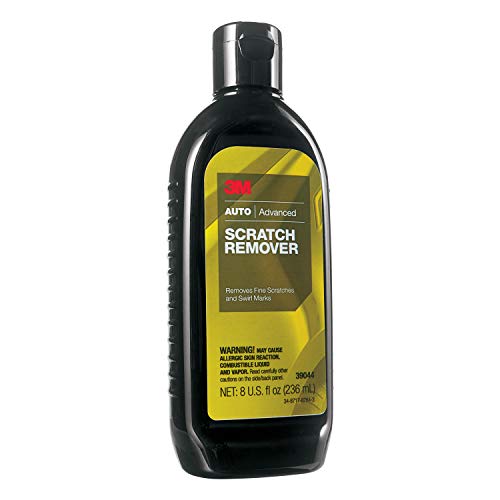
3M built its name in professional body shops, and this scratch remover carries that heritage into a consumer bottle. The formula is a fine-grade rubbing compound aimed at light scratches, swirl marks, and minor surface imperfections, and it is formulated to work by hand or with an orbital or rotary polisher. Body shops value it because the cut is predictable and the finish wipes clean without oily fillers masking the true result.
That honesty is its main appeal for careful owners: what you see after wiping is the actual corrected surface, not a temporary fill. It handles the typical mix of wash marring and shallow scratches well, and the 8 fl oz bottle goes a long way on spot repairs. It sits between ScratchX and Ultimate Compound in aggressiveness, closer to the fine end, so deep or wide defects will need repeated applications or a stronger product. Keep the work area clean, since trapped grit under a pad can add scratches faster than the compound removes them. Owners who prefer professional-grade consumables and a no-nonsense formula will find this the most familiar-feeling option in the group.
How to choose
Start with the fingernail test. Run a fingertip lightly across the scratch: if the surface feels smooth and the mark looks white or hazy, it is probably confined to the clear coat and a remover can help. If your nail catches in a groove, the scratch has likely reached the base coat or primer, and no compound will restore it fully.
Next, match aggressiveness to the defect. Fine removers like ScratchX and the 3M formula suit swirls and shallow marks. Fill-and-blend products like the Turtle Wax option suit broad, faint scuffing. A cutting compound like Ultimate Compound is for oxidation and heavier defects, and a drill kit is for isolated scratches where hand effort falls short. Always begin with the least aggressive product that could work, test in a hidden spot, and work on a washed, cool panel in the shade. Finish every correction with wax or sealant, because polishing strips whatever protection was on the paint.
Who should skip
Skip scratch removers if the damage reaches primer or bare metal, if the paint is cracked, peeling, or bubbling, or if the panel has a matte or satin finish that polishing would shine unevenly. Very thin or previously over-polished clear coat is another reason to stop, since further cutting risks burning through to the color layer. Owners of ceramic-coated cars should also pause: compounds will remove the coating in the worked area, so the panel will need re-coating afterward. In those cases, touch-up paint, a body shop consultation, or simply living with the mark is the smarter call.
FAQ
Can a scratch remover fix deep scratches?
No. Removers level the clear coat around a shallow defect until it disappears, but they cannot replace missing paint. If a scratch catches your fingernail, shows a different color at its base, or reaches metal, it needs touch-up paint or professional repair. Compounds can soften the edges of a deeper scratch and make it less visible, but the groove itself will remain.
Are scratch removers safe for clear coat?
Yes, when used as directed, because the products in this guide are formulated for clear coat finishes. They remove a very thin layer of the surface, which is why gradual work and frequent inspection matter. Avoid aggressive compounds on thin, old, or previously repaired paint, and never keep polishing one spot for a long time, since heat and friction can damage the finish.
Do I need a machine polisher to use a scratch remover?
No. Every product here can be applied by hand with a foam applicator or microfiber towel, and hand work is safer for small areas. A dual-action polisher speeds up large panels and gives more even results, while the drill-powered kit in this guide offers a middle path for isolated scratches. Whatever the method, moderate pressure and short working cycles matter more than raw speed.
Should I wax after using a scratch remover?
Yes. Polishing removes the wax or sealant that was protecting the panel, leaving the corrected area exposed to ultraviolet light and road grime. Once the defect is gone and the residue is wiped away, apply a wax or paint sealant over the whole panel so the repaired spot weathers at the same rate as the surrounding paint.
Final verdict
Most owners should start with Meguiar’s ScratchX for light scratches and swirls, since its controlled cut is the most forgiving. Choose Turtle Wax Scratch Repair and Renew for broad, faint scuffing, the Quik Scratch Eraser Kit when one stubborn mark needs drill power, Ultimate Compound for oxidation and heavier defects across large panels, and the 3M Scratch Remover for a professional-grade fine compound. Whatever you pick, work gently, inspect often, and protect the finish afterward.
More from Amazon
Programs that pair well with the guide above. Offers and eligibility are set by Amazon and may change.
Free shipping on eligible items, Prime Video and more. Eligible new members can start with a free trial.
Start a Prime free trialAudiobooks and podcasts to listen to on the go. Eligible new members can start with a free trial.
Try Audible freeAd-free music streaming. Eligible new subscribers can start with a free trial.
Try Music Unlimited freeA free business account with business pricing and bulk-buying tools for work, shop or home office.
Create a business accountAs an Amazon Associate we earn from qualifying purchases.