Key takeaways
- Compare the best car first aid kits, from compact commuter kits to a full trauma-ready set with labeled compartments for glovebox, trunk and travel.
A first aid kit is the one car accessory you buy hoping never to open, and the quality differences only show up on the worst day: a cut at a trailhead, a burned hand at a campsite, a fender bender far from help. The kits in this guide range from a compact commuter pouch to a trauma-focused set built for serious bleeding control, and all five are sized for a glovebox, console, or trunk corner. The right choice depends on who rides in your car, how far you drive from medical care, and whether you want basic bandage-and-ointment coverage or genuine emergency capability.
As an Amazon Associate, we earn from qualifying purchases.
Quick answer
The Surviveware 238-piece kit is the best-organized all-rounder here, with labeled compartments that make items easy to find under stress. The My Medic MyFAK is the trauma-ready pick, First Aid Only’s 298-piece set suits families, and the Be Smart and Protect Life kits cover commuters and travelers who want compact, simple coverage.
Surviveware 238 Pcs Comprehensive Premium Survival First Aid Kit

Organization is the Surviveware kit’s defining feature. Each category of supplies sits in its own labeled compartment inside the 600D polyester case, so bandages, wound care, and tools can be found by touch and by label instead of by emptying the kit onto the ground. That layout matters in a real emergency, when the person digging through the kit may be stressed, gloved, or working one-handed. The case is water-resistant and rip-resistant, with MOLLE-compatible straps, a removable Velcro panel, and D-rings for mounting to a headrest, roll bar, or pack.
The contents cover everyday injuries and a step beyond: a removable CPR pouch, a first aid guide, and a broad spread of bandages, dressings, and tools across 238 pieces. The case measures about 10 by 7.5 by 5 inches, which fits a trunk side pocket, under-seat space, or the back of a seat rather than a small glovebox. The kit is FSA and HSA eligible, a practical detail for buyers who stock safety gear with those funds. For drivers who want one thorough, well-sorted kit for family road trips and outdoor weekends, this is the most complete general-purpose option in the group.
My Medic MyFAK Standard First Aid Kit, Red

The MyFAK is built for the emergencies that go beyond scrapes: it packs 132 trauma and first aid items selected for bleeding control and serious injury, in a compact IFAK-style bag that mounts with MOLLE-compatible straps. Where most car kits are really bandage boxes, this one is designed around the first minutes after a crash or a serious accident, with supplies organized for fast access rather than tidy categories. The red case is easy to spot in a dark trunk or a ditch-side scramble, and the kit is HSA and FSA eligible.
That focus cuts both ways. A trauma kit assumes the user has, or will get, basic training in how to use its contents; gear you cannot use confidently is dead weight. Drivers who spend long hours on rural highways, tow trailers, ride along to remote job sites, or simply want the car prepared for a worst case will get the most from it. For a school-run commuter, the simpler kits below are honestly sufficient. But as the one kit in this guide aimed squarely at life-threatening injuries rather than minor ones, the MyFAK fills a role none of the others attempt, and it does so in a bag that takes up little room.
First Aid Only 298 Piece All-Purpose Emergency First Aid Kit, FAO-442

First Aid Only is a long-standing name in workplace first aid, and this 298-piece kit brings that checklist approach to the car. The soft zippered case uses clear interior pockets so contents are visible at a glance, and the assortment covers the everyday list thoroughly: adhesive bandages in several sizes, antibiotic ointment, antiseptic towelettes, burn cream, gauze pads, an instant cold compress, moleskin for blisters, gloves, an emergency blanket, scissors, and tweezers. At roughly 9.25 by 2.875 by 7 inches, the case is flatter than most, sliding into a seat-back pocket or a packed trunk without eating much space.
This is the family pick of the group. The injuries most car kits actually treat are small cuts, scrapes, blisters, splinters, and minor burns, and this kit stocks those supplies in depth rather than spreading its count across exotic items. Parents will appreciate the breadth for playground and road-trip duty, and the clear-pocket layout makes restocking obvious: you can see what is missing. It is not a trauma kit and does not pretend to be. For households that want one affordable-feeling, comprehensive basics kit maintained over years of family driving, it is the natural fit.
Be Smart Get Prepared 110 pc First Aid Kit
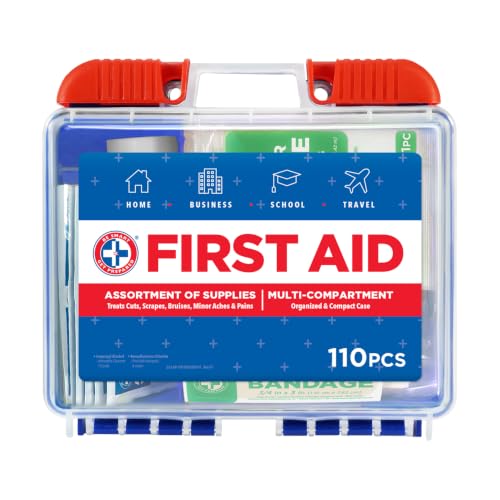
The Be Smart Get Prepared kit is the compact, keep-it-simple option: 110 pieces of core first aid supplies in a small soft case sized for a glovebox, console, or daypack. The assortment covers the fundamentals for cuts, scrapes, and minor injuries at home, in the office, or on the road, and the brand’s kits are FSA and HSA eligible. There is no elaborate organization system and no trauma gear, which is precisely the point for a second kit or a commuter car.
Think of this as the kit that makes sure every vehicle in the household has something. A thorough kit in the family SUV does nothing for the sedan taken to work, and a basic kit in hand beats a premium kit in the other car. The small footprint also suits motorcycle saddlebags, boats, and dorm rooms. Supplies are consumable and dated, so a modest kit you replace on schedule can be a smarter buy than a huge kit that quietly expires. Drivers who want straightforward coverage for minor injuries, in the smallest reasonable package, will find this little case easy to justify and easy to stash.
Protect Life First Aid Kit

The Protect Life kit is a starter emergency kit aimed at car and travel use, packing the everyday essentials into a compact soft case that disappears into a glovebox or carry-on. It covers the standard minor-injury list, bandages, antiseptic care, gauze, and basic tools, in a format designed to be grabbed without thinking. The case is made to shrug off the knocks of life in a trunk or travel bag, and the layout keeps the contents visible and reachable rather than buried.
This is a sensible first kit for a new driver, a college student’s first car, or a rental-car travel kit that flies with you and drops into whatever you are driving. It does not try to match the depth of the Surviveware or the trauma focus of the MyFAK, and buyers planning remote travel should step up to those. What it offers is the essential coverage most people actually use, in the size most people will actually keep in the car. A kit that stays in the vehicle is worth more than a bigger one left in the garage, and the Protect Life’s compact footprint is built around exactly that habit.
How to choose
Match the kit to the driving you do. Daily commuting and school runs need bandages, antiseptic care, blister and burn basics, and tweezers; long rural drives and outdoor trips justify trauma supplies and an emergency blanket. Organization matters more than raw piece counts, since counts are easily padded with tiny bandages: look for labeled compartments or clear pockets you can search quickly. Check the case size against the space you have actually assigned, because a kit that does not fit will migrate to the garage. Note whether contents include items with expiry dates, and pick a kit you can restock or replace on a schedule. FSA and HSA eligibility is a useful bonus on several kits here.
Who should skip
Skip the trauma-focused kit if nobody in the household has or plans to get basic first aid training; its supplies only help in hands that know them, and a well-organized basics kit will serve you better. Skip the largest kits if your only storage is a small glovebox, since an oversized kit ends up left at home. Drivers who already maintain a full home kit and a hiking kit may only need a compact commuter pouch for the car rather than another comprehensive set. And if your kit will sit in a hot trunk for years without ever being checked, choose a small kit you will replace often over a premium one that quietly expires.
Frequently asked questions
What should a car first aid kit include at minimum?
Bandages in assorted sizes, gauze pads, adhesive tape, antiseptic wipes or solution, antibiotic ointment, tweezers, scissors, disposable gloves, and an emergency blanket cover the large majority of roadside needs. Add an instant cold compress, moleskin for blisters, and any personal medication your passengers rely on. Trauma supplies such as a tourniquet belong in kits carried by trained users.
How often should I check or replace a car first aid kit?
Look through it at least once a year, and after any use. Ointments, antiseptic wipes, and adhesive bandages lose effectiveness with age, and car interiors expose them to heat cycles that shorten their life. Replace expired or dried-out items, restock anything you used, and confirm the case still closes and sits where you expect it. Many owners tie the check to a seasonal tire or oil change.
Where is the best place to store a first aid kit in a car?
Somewhere reachable without leaving the driver’s seat area in a minor incident, or at least somewhere consistent: a glovebox, center console, seat-back pocket, or a fixed trunk corner. Under a pile of cargo is the worst option. If the kit has straps or D-rings, mounting it to a headrest or trunk side keeps it findable in the dark and prevents it sliding around.
Is a bigger piece count always better?
No. Piece counts are dominated by small bandages and cotton items, so a high count can hide a thin spread of genuinely useful supplies. Judge a kit by the range of situations it covers, the quality and organization of the case, and whether you can find items fast. A well-sorted 110-piece kit can outperform a jumbled 300-piece box in a real moment.
Final verdict
The Surviveware kit is the strongest all-round choice for most drivers thanks to its labeled organization and broad contents. The MyFAK is the deliberate pick for trauma readiness, First Aid Only’s set serves families best, and the Be Smart and Protect Life kits keep secondary cars and travelers covered without bulk. Pick the kit that matches your training and your trunk space, then put a yearly check on the calendar so it is ready when it is needed.
More from Amazon
Programs that pair well with the guide above. Offers and eligibility are set by Amazon and may change.
Free shipping on eligible items, Prime Video and more. Eligible new members can start with a free trial.
Start a Prime free trialAudiobooks and podcasts to listen to on the go. Eligible new members can start with a free trial.
Try Audible freeAd-free music streaming. Eligible new subscribers can start with a free trial.
Try Music Unlimited freeA free business account with business pricing and bulk-buying tools for work, shop or home office.
Create a business accountAs an Amazon Associate we earn from qualifying purchases.