Key takeaways
- Find the best car air conditioner condenser for your vehicle. Compare direct-fit A/C condensers for Honda, Nissan, and GM models with fitment guidance.
The best car air conditioner condenser is the one that matches your exact year, make, model, and engine, bolts into the factory mounting points, and restores cold air without modification. A condenser is not a universal part in practice, even when a listing calls it universal, because core size, line fittings, mounting brackets, and receiver drier placement all vary from one vehicle to another. Choosing the wrong one can mean lines that do not line up, a fan shroud that will not seat, or a part that looks close but cannot be installed at all.

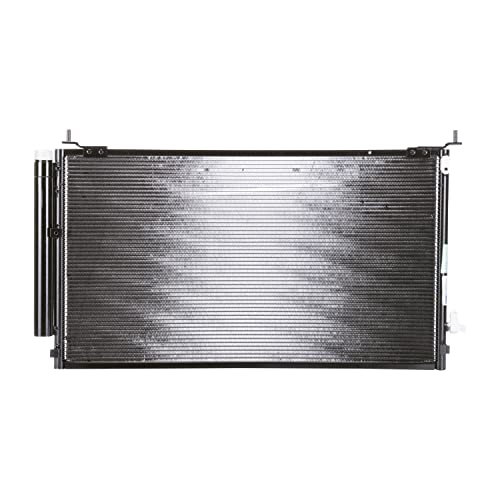
Quick answer: for most drivers, a direct-fit, vehicle-specific condenser from a recognized aftermarket brand is the sensible choice. The five options below cover popular Honda Accord and Civic models, Nissan Altima and Maxima models, and full-size GM trucks and SUVs. Each one is an automotive A/C condenser only, not a compressor, recharge kit, or underdash kit, and each listing states the vehicles it is made to fit.
Quick Picks
Our Short List of 3
All 5 Picks at a Glance
| Product | Specs | Action |
|---|---|---|
| A-Premium A/C Condenser with Receiver Drier for Honda Accord 2013-2017 | Check price on Amazon | |
| TYC 3569 Condenser Assembly for Honda Civic 2006-2011 | Check price on Amazon | |
 Kool Vue A/C Condenser for Honda Accord 2008-2012 and Crosstour | Check price on Amazon | |
 CM COMPRESSOR A/C Condenser for GMC, Chevrolet, and Cadillac Trucks and SUVs | Check price on Amazon | |
 A-Premium A/C Condenser for Nissan Altima 2013-2018 and Maxima 2016-2021 | Check price on Amazon |
How to Choose
A car air conditioner condenser sits at the front of the vehicle, usually ahead of the radiator, where airflow carries heat away from the refrigerant. Hot, high-pressure refrigerant gas from the compressor enters the condenser, sheds heat through its fins and tubes, and leaves as a cooler liquid on its way to the evaporator inside the cabin. When the condenser is clogged, bent, leaking, or internally blocked, cabin cooling suffers, system pressures rise, and the compressor works harder than it should. Replacement is often the right repair when the part is damaged in a front-end impact, corroded by road salt, or leaking at a seam or fitting.
Match the Exact Vehicle Fitment First
Fitment is the first filter, and it is also the one most often skipped. A condenser for a 2013 Honda Accord with a 2.4L engine is not automatically correct for a 2013 Accord with a different engine, trim, or transmission cooler arrangement, and a part listed for a range of years may still exclude certain submodels. Before you order, write down the year, make, model, engine size, body style, and trim of your vehicle, then compare that information with the compatibility list on the product page, not just the headline.
Choose Parallel Flow Construction
Most modern replacement condensers use a parallel flow core, in which refrigerant passes through many small parallel tubes with fins between them. This design gives a large surface area in a compact package and transfers heat efficiently, which is why it is standard on the vehicles covered in this guide. A serpentine condenser, with a single winding path, is an older design and is generally not a direct substitute for a parallel flow part. When a listing states the core type, look for parallel flow
Check Core Dimensions and Line Fittings
Even within the same model family, core length, width, and thickness can differ, and the inlet and outlet fittings must line up with the refrigerant lines already in your car. A condenser that is a fraction of an inch too wide may not seat between the radiator support brackets, and a fitting in the wrong position cannot be forced into place without damaging a line or an O-ring seal. The A-Premium Accord condenser in this guide, for example, lists a core length of 17 15/16 inches, a core width of 32 1/8 inches, and a core thickness of 3/4 inch. Compare those measurements with your original part when you can.
Look for an Included Receiver Drier
Many condensers include a receiver drier, which filters moisture and debris from the refrigerant. Some include the drier as a separate canister attached to the condenser, while others have it built into the condenser body. A few are sold without a drier at all, which means you would need to source one separately. As a general practice, a receiver drier should be replaced whenever the A/C system is opened for a major repair, so a condenser that arrives with a new drier saves a separate purchase and a separate step.
Consider Aluminum Construction and Leak Testing
Automotive condensers are almost always made from aluminum, which is light, resists corrosion reasonably well, and transfers heat effectively. What varies is the quality of the welds, the fin density, and the factory testing. Look for listings that state the part is new, leak-tested before leaving the factory, and built to meet or exceed original equipment specifications.
Confirm What Is Included and What Is Not
A condenser listing may include mounting hardware, O-rings, or a bracket, or it may include none of those. The A-Premium Honda Accord condenser in this guide includes a receiver drier but no bracket, and it does not fit the model with the L4 2.0L engine. The Nissan A-Premium condenser in this guide does not come with O-rings, and it excludes certain 2015 Altima variants, as noted in its section below. Read the attention notes on the product page before ordering.
Plan for Professional Evacuation and Recharging
Replacing a condenser is not a simple bolt-on job in the way a filter change is. The A/C system must be evacuated with proper recovery equipment before it is opened, and it must be vacuumed and recharged with the correct refrigerant type and quantity after the new part is installed. Refrigerant should never be vented into the air, and the system should not be opened without a plan to seal it again promptly, because moisture entering the system can damage the compressor and the drier.
The Best Best Car Air Conditioner Condenser Reviewed
The five condensers below are all automotive A/C condensers sold on Amazon US, each made for specific vehicles. None of them is a compressor, a recharge kit, or an underdash air conditioning kit. Fitment is stated for each product, and any partial-fit limitation found in the listing is flagged in its section.
A-Premium A/C Condenser with Receiver Drier for Honda Accord 2013-2017
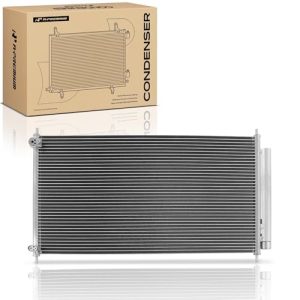
This A-Premium condenser is a direct bolt-on original equipment replacement for the Honda Accord from 2013 through 2017, covering both the L4 2.4L and the V6 3.5L engines. It is made from aluminum with a parallel flow core, the design used on these Accord models from the factory, and it is built to maximize cooling efficiency and speed up heat dissipation. The listing states that all A-Premium condensers meet or exceed original equipment specifications, and the part carries a one-year unlimited-mileage guarantee from the manufacturer.
The core dimensions are listed as 17 15/16 inches long, 32 1/8 inches wide, and 3/4 inch thick, with metric equivalents of 385 mm, 691 mm, and 16 mm. A receiver drier is included, which is useful because the drier should be replaced when the system is opened. The manufacturer part number is APCON670, and the reference numbers include 4165, 940466, and 80110T2FA01, which can be used to cross-check against the original part or a catalog listing.
Partial-fit flag: this condenser comes with a receiver drier but without a bracket, and it does not fit the Accord model with the L4 2.0L engine. Confirm your engine size and check whether your installation needs the original bracket transferred from the old condenser. This is a strong option for Accord owners inside the stated fitment.
TYC 3569 Condenser Assembly for Honda Civic 2006-2011
The TYC 3569 is a condenser assembly made for the Honda Civic from 2006 through 2011. TYC is a long-established aftermarket brand, and the product description states that every TYC condenser is leak-tested and test-fit on actual vehicles before leaving the factory. The construction is described as similar to original equipment, with attention to the number of tubes, the quantity of cooling fins, and the position of mounting brackets and inlet and outlet fittings.
The core is made from aluminum, and the assembly is designed to complement and optimize the vehicle air conditioning system. The listing is sold by Amazon.com, and the item weight is listed as 5 pounds, which is consistent with a compact aluminum condenser for a Civic. Confirm the exact Civic trim and engine against the compatibility list before ordering, and plan to replace the receiver drier and seals at the same time if the system is opened.
Kool Vue A/C Condenser for Honda Accord 2008-2012 and Crosstour
This Kool Vue condenser covers a wider set of Honda models than the other Honda options in this guide. It is made for the Honda Accord from 2008 through 2012, the Accord Crosstour from 2010 through 2011, and the Crosstour from 2012 through 2015, with 2.4L and 3.5L engines. The item model number is KVAC3669, and the manufacturer part number is the same. The original equipment reference number is 80110TA0A01, with related references including 3669, 73669, 10464, and HO3030151.
The condenser weighs 7.09 pounds and measures 32 by 19 by 4 inches in its packaged dimensions. The listing covers several Accord and Crosstour trims, including SE, LX, EX, EX-L, LX-P, LX-S, and HFP variants. Because the fitment spans several model years and two nameplates, use the reference number 80110TA0A01 as a cross-check before ordering.
CM COMPRESSOR A/C Condenser for GMC, Chevrolet, and Cadillac Trucks and SUVs
This CM COMPRESSOR condenser is made for full-size GM trucks and SUVs, including GMC Sierra 1500, 2500, and 3500 models, GMC Yukon and Tahoe, Chevrolet Silverado, and Cadillac Escalade models, with the original equipment reference GM3030161. The manufacturer part number is CL3026, and the related original equipment numbers include 25807797 and GM3030161. The part is listed as a new automotive A/C condenser, first available in January 2021, with product dimensions of 35 by 0.63 by 17.25 inches and an item weight of 7 pounds.
The listing describes the part as a direct-fit, original equipment quality condenser that requires no drilling or modification, and it states that the part is fully leak tested.
Partial-fit flag: the fitment for this part is broad, and GM used several different condenser designs across these model lines and years, including variations for vehicles with and without rear air conditioning and with different transmission cooler arrangements. Confirm the GM3030161 reference number and your exact model year, engine, and rear air conditioning setup before ordering.
A-Premium A/C Condenser for Nissan Altima 2013-2018 and Maxima 2016-2021
This A-Premium condenser is a direct original equipment replacement for the Nissan Altima from 2013 through 2018 and the Nissan Maxima from 2016 through 2021, covering 2.5L and 3.5L engines. The manufacturer part number is APCON665PC, and the reference numbers include 4128, CN4128PFC, 921003TA1A, 921003TA3B, and NI3030171. It uses a parallel flow aluminum core and is described as a brand-new condenser and receiver drier assembly, designed for a direct bolt-on installation with original equipment fit and quality.
The item weight is listed as 6.89 pounds, and the part is made by PremiumpartsWhosale, the manufacturer behind the A-Premium brand. The fitment covers Altima sedan models with the 2.5L engine and Altima models with the 3.5L engine, along with Maxima models with the 3.5L engine. A built-in receiver dryer bracket is part of the design, which helps with mounting and with protecting the air conditioning system.
Partial-fit flag: this condenser is not compatible with Altima L4 2.5L Advance and Sense variants or Altima V6 3.5L Exclusive variants from 2015, according to the listing details, and it does not come with O-rings. It also does not include refrigerant oil, so that will need to be purchased separately if your installer requires it. Check your exact Altima trim before ordering and buy new O-rings for the installation.
What to Check Before You Buy
Before you order, confirm the vehicle details in writing: year, make, model, engine size, trim, and whether the vehicle has rear air conditioning or a transmission oil cooler that shares mounting space with the condenser. Find the original equipment part number on the old condenser, in the owner’s manual, or through a dealer parts lookup, and compare it with the reference numbers in the listing. Read the attention notes on the product page for exclusions, such as a missing bracket, missing O-rings, or a trim that is not covered. Check whether a receiver drier is included and, if it is not, order one to match.
Also inspect the rest of the system before you commit to a condenser alone. A condenser often fails after a front-end impact or after debris strikes the front of the vehicle, and the same event can damage the radiator, the fan, or the refrigerant lines. A compressor that has failed internally can send debris through the system, and in that case a condenser replacement alone may not restore cooling. If the system has been open to air for a long time, moisture may have entered, and the drier and seals become even more important.
Finally, keep the packaging and the part number until the installation is complete. Condensers are large, thin, and easily bent, and the fins are delicate. If the part arrives with bent fins, a cracked fitting, or a dented core, do not install it. Contact the seller promptly and keep the original packaging for a return.
FAQ
How do I know if my car air conditioner condenser is bad?
Common signs include air from the vents that stays warm or cools only weakly, visible damage or bent fins at the front of the vehicle, refrigerant leaks or oily residue around the condenser fittings, and unusually high system pressures. A condenser can also be blocked internally, which restricts refrigerant flow and reduces cooling. Weak cooling can also come from a low refrigerant charge, a failed compressor, or a clogged cabin filter, so a proper diagnosis with pressure gauges and a leak check is the reliable way to confirm the cause.
Can I replace a car A/C condenser myself?
The mechanical part of the job, removing the front fascia or grille, unbolting the old condenser, and fitting the new one, is within reach of an experienced home mechanic on many vehicles. The refrigerant work is not. The system must be evacuated with recovery equipment before it is opened, and it must be vacuumed and recharged with the correct refrigerant and quantity afterward.
Do I need to replace the receiver drier with the condenser?
In most cases, yes. The receiver drier absorbs moisture and filters debris, and it should be replaced whenever the air conditioning system is opened for a major repair, including a condenser replacement. If your chosen condenser does not include one, order a matching drier and have it installed at the same time.
How long does a replacement A/C condenser last?
A replacement condenser can last for many years when it fits correctly, the system is clean, and the refrigerant charge is correct. Its life depends on driving conditions, exposure to road debris and salt, and whether the rest of the system is in good condition. Regular use of the air conditioning system, even in cooler months, helps keep seals lubricated.
What is the difference between a condenser and a radiator?
A condenser and a radiator look similar because both are finned heat exchangers mounted at the front of the vehicle, but they serve different systems. The radiator cools engine coolant, while the condenser cools and condenses refrigerant in the air conditioning system. They are not interchangeable, and a part number for one will not fit the other.
Bottom Line
The best car air conditioner condenser for your vehicle is a direct-fit, vehicle-specific part with a parallel flow aluminum core, a stated receiver drier arrangement, and reference numbers you can verify against your original part. Start with exact fitment, check the core dimensions and line fittings, and read the attention notes for exclusions before you order. For Nissan Altima and Maxima owners, the A-Premium condenser covers the 2013-2021 range with specific 2015 trim exclusions to watch for. For full-size GM truck and SUV owners, the CM COMPRESSOR condenser covers the listed Sierra, Silverado, Tahoe, Yukon, and Escalade models under reference GM3030161.
Whichever option matches your vehicle, have the system evacuated and recharged by a qualified technician, replace the drier and seals while the system is open, and keep the part number and packaging until the job is done. A careful fitment check before ordering is the single step that most often separates a smooth repair from a return.
Disclosure: As an Amazon Associate, we may earn from qualifying purchases.
More from Amazon
Programs that pair well with the guide above. Offers and eligibility are set by Amazon and may change.
Free shipping on eligible items, Prime Video and more. Eligible new members can start with a free trial.
Start a Prime free trialAudiobooks and podcasts to listen to on the go. Eligible new members can start with a free trial.
Try Audible freeAd-free music streaming. Eligible new subscribers can start with a free trial.
Try Music Unlimited freeA free business account with business pricing and bulk-buying tools for work, shop or home office.
Create a business accountAs an Amazon Associate we earn from qualifying purchases.