Key takeaways
- Pedestal or box fan: Cheaper per unit of air moved, and more powerful, but bulkier and less tidy.
- Dyson Cool AM07 (non-purifying): One outlet calls it the premium benchmark for build and smooth airflow. It is an older design, so confirm availability with the maker.
- Portable air conditioner or evaporative cooler: If you need real temperature reduction rather than air movement, a fan alone will not do it.
The Dreo Cruiser Pro T1 suits most buyers who want a quiet, good-value bladeless-style tower fan, the Lasko tower line suits shoppers who want the most airflow for the least spend, and the Dyson Purifier Cool suits people who want a fan that also filters air and are willing to pay premium money for it. A true bladeless fan, such as a Dyson, pulls air through a base and pushes it out of a loop or slot. Many “bladeless tower fans” sold under other brands hide their blades inside a tall housing, so the look is similar but the mechanism is not. That distinction affects noise, cleaning and price, so it is worth sorting out before you compare models.
Our top picks



As an Amazon Associate we earn from qualifying purchases at no extra cost to you.
At a Glance
| Model | Best for | Key stated specs | Limits |
|---|---|---|---|
| Dreo Cruiser Pro T1 | Bedrooms and most living rooms | About 42 in tall, DC motor, 90-degree oscillation, remote, timer up to 12 hours; listings differ on 6 or 9 speeds and on 20 to 28 dB claims | Independent noise readings run higher than the maker figures |
| Dreo 42-inch bladeless tower | Quiet sleep use | The maker and reviewers cite very low noise on the lowest setting and eight speeds | Reviewers measured useful airflow well short of the headline throw distance |
| Lasko tower (such as the T42951) | Tight budgets and large rooms | About 42.5 in tall, 3 speeds, 7.5-hour timer, remote | AC-motor design is louder at top speed |
| Dyson Purifier Cool (TP10 and newer) | Year-round air cleaning plus cooling | The maker lists sealed HEPA H13 plus activated carbon filtration, 350-degree oscillation, 10 airflow settings, filter replacement about every 12 months | Premium cost, and filters are a recurring expense |
| Shark TurboBlade | Bladeless-looking design with strong output | Listed by one outlet as its best bladeless pick | Upper mid-range cost; confirm current model details with the maker |
Dreo: The Best-Value Pick
Roundups in 2026 repeatedly name Dreo as the fan to buy for most rooms. The Cruiser Pro T1 stands about 42 inches tall and uses a DC motor, which gives finer speed control and generally quieter running than the AC motors found in budget tower fans. It comes with a remote, a timer that runs up to 12 hours, four modes including a natural-breeze setting and a sleep mode, and 90-degree oscillation.
Specifications vary by listing. Older listings describe six speeds and a noise level of 28 dB, while current listings describe nine speeds and a figure as low as 20 dB on the lowest setting. Independent readings are higher: Forbes recorded a range of roughly 42 to 52 dB, and BestReviews measured about 41 dB on the second speed. That is still quiet, comparable to a soft conversation, but not silent. Maker dB figures are usually taken at the lowest setting in a controlled room, so expect more sound than the box suggests.
Dreo also sells a 42-inch bladeless-style model that one reviewer rated the best overall bladeless tower for its eight speeds and low noise. That reviewer measured steady air movement at about 28 feet, well short of the 90 feet in the headline claim. The takeaway is to treat throw-distance numbers as ceilings. For a bedroom or office, a fan that comfortably covers 10 to 15 feet is plenty.
Lasko: The Budget and Power Option
Lasko’s tower fans are the usual answer for shoppers who care more about moving air than about sound or looks. The T42951 is a popular example, listed at about 42.5 inches tall with three speeds, a 7.5-hour timer and a remote. Reviewers note that AC-motor fans like this are cheaper upfront but louder at maximum speed, and that Lasko generally delivers high raw airflow for larger spaces. A newer Lasko Elevation DC model gets recommended for tall rooms that need extended reach.
The trade-off is the sound profile. If the fan will run beside a bed, a DC-motor model such as the Dreo will usually be easier to live with. If it will run in a garage, workshop or large open room where background noise already exists, Lasko’s power is an advantage.
Dyson: Premium and Purifying
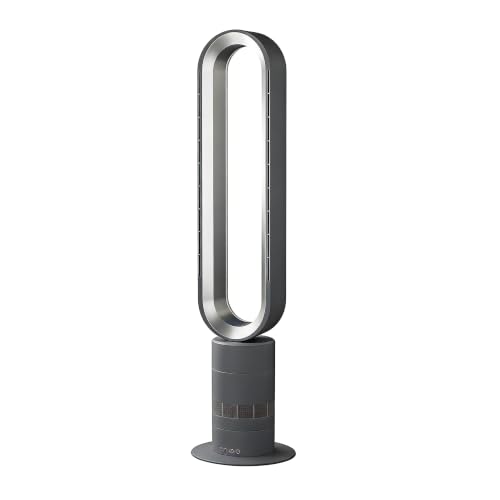
Dyson is the only brand here that truly uses bladeless Air Multiplier technology. Its current Purifier Cool models pair a fan with a sealed filtration system. The maker lists a combined glass HEPA and activated carbon filter, sealed to H13 standard, a 350-degree oscillation range, 10 airflow settings, a remote, an LCD display showing air quality and sleep timer intervals of one, two, four and eight hours. Dyson recommends replacing the filter about every 12 months. Retail listings give the TP10 coverage of roughly 100 square feet and a weight near 10 lb.
Reviewers are candid about the limits. One outlet describes Dyson’s recent models as air purifiers that also cool, rather than the reverse, and another suggests a fan like the Dreo can move similar amounts of air for much less. The Dyson makes the most sense when you want filtration in the same unit, for example for pollen season or smoke events. If you only need to cool a room, the extra cost buys design and filtration you may not use.
A cautionary note for anyone with allergies or respiratory conditions: an air purifier is not a medical device, and a fan with a filter does not replace advice from a doctor. Follow the manual for filter changes.
Buying Notes: Size, Noise and Care
Room size
Tower fans are best for personal and small-room cooling. Match height to where you sit: a 40-plus-inch tower covers a sofa or bed from the floor, while a shorter fan needs a stand. Oscillation wider than 70 degrees helps cover a seating area, and a narrow 40-degree sweep is better for directing air at one person.
Noise
Look for DC-motor fans if you plan to sleep next to the unit. Independent readings from reviewers are more reliable than the maker claim. Expect numbers to rise sharply at the top speeds.
Cleaning
True bladeless fans are quick to wipe down because there are no exposed blades, though the base intake and the filter, if any, still need attention. Tower fans with internal blades collect dust inside the housing, so look for a model with a removable grille or a documented cleaning method. Always unplug a fan before cleaning it.
Safety
Keep the fan on a flat surface, do not run it with the cord pinched under furniture, and keep it away from water. Check the manual for the maker’s guidance on child and pet safety. Bladeless designs reduce the chance of fingers reaching a spinning blade, but small gaps in a grille or base can still be a concern.
Pick X If… Decision Table
| Pick this | If you |
|---|---|
| Dreo Cruiser Pro T1 | want quiet, a DC motor and a remote at a mid-range cost |
| Dreo 42-inch bladeless tower | mainly need a bedroom fan with a low sleep-mode noise |
| Lasko T42951 or Elevation DC | want maximum airflow for a lower budget in a larger room |
| Dyson Purifier Cool | want filtration and cooling in a single premium unit |
| Shark TurboBlade | like the bladeless look and want a strong mid-to-premium fan |
Alternatives
- Pedestal or box fan: Cheaper per unit of air moved, and more powerful, but bulkier and less tidy.
- Dyson Cool AM07 (non-purifying): One outlet calls it the premium benchmark for build and smooth airflow. It is an older design, so confirm availability with the maker.
- Portable air conditioner or evaporative cooler: If you need real temperature reduction rather than air movement, a fan alone will not do it.
Frequently Asked Questions
Are bladeless tower fans really bladeless?
Only some are. Dyson-style fans use an internal impeller in the base and push air out through a loop or slot, so there are no exposed blades. Many other “bladeless” towers have blades or a cross-flow impeller hidden inside the housing, so check the product description.
Are bladeless fans quieter?
Not automatically. Noise depends mainly on motor type and airflow. A DC-motor tower from Dreo is reported to be quiet at low speeds, while a bladeless Dyson can be louder at high speed than its smooth air suggests. Independent decibel readings are more helpful than a single marketing number.
Does a bladeless fan cool the room?
No fan lowers the room temperature. It moves air across your skin so you feel cooler through evaporation. Turn off the fan when you leave the room, since it does not help an empty space.
Is a Dyson worth the extra cost?
It can be if you want its sealed HEPA filtering and design. If you only want cooling, reviewers say less expensive fans move comparable air. Factor in the recurring cost of replacement filters.
How often should I clean a tower fan?
Wipe the exterior and air intake every few weeks in dusty homes, and clean internal parts according to the manual. Unplug the unit first. Replace purifier filters on the schedule the maker gives.
Is it safe to leave a fan on overnight?
Fans are designed for extended use when placed on a stable surface with the cord clear of obstructions. Follow the manual, avoid covering the intake, and use the timer if you prefer. If a fan smells of burning, makes new noises or runs hot, unplug it and contact the maker.