Key takeaways
- 40°F incoming water: 80°F rise
- 50°F incoming water: 70°F rise
- 60°F incoming water: 60°F rise
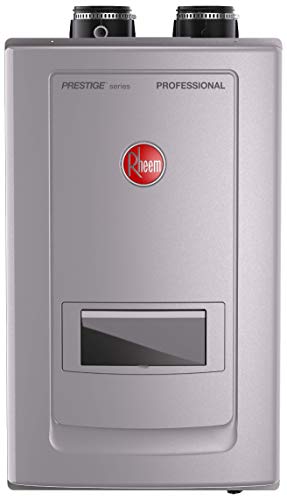
The best condensing tankless gas water heaters are the Rinnai RU199iN for high-demand homes, Navien NPE-240S2 for built-in recirculation flexibility, Noritz NRCB199DV for a compact high-output installation, and a 150,000–160,000 BTU model for smaller households that do not need maximum flow.
Our top picks



As an Amazon Associate we earn from qualifying purchases at no extra cost to you. Ratings are shown as listed on Amazon.
Best condensing tankless gas water heaters by household
| Best for | Recommended type or model | Maximum input | Published maximum flow | Efficiency | What makes it a good fit |
|---|---|---|---|---|---|
| Large household and simultaneous use | Rinnai RU199iN | 199,000 BTU/h | Up to 11.0 GPM | Up to 0.98 UEF | High output, indoor installation, broad control options |
| Recirculation and convenient hot-water delivery | Navien NPE-240S2 | 199,900 BTU/h | Up to 11.1 GPM | Up to 0.97 UEF | Internal recirculation pump and buffer tank |
| Compact, high-output replacement | Noritz NRCB199DV | 199,900 BTU/h | Up to about 11.1 GPM | Up to about 0.97 UEF | Commercial-grade condensing design and cascades |
| Two- to three-person home with moderate demand | Condensing unit in the 150,000–160,000 BTU range | 150,000–160,000 BTU/h | Typically 7.5–9.0 GPM | About 0.95–0.98 UEF | Lower gas demand and often lower purchase cost |
Flow figures are maximum ratings under favorable temperature conditions, not guaranteed shower flow. Actual performance depends on incoming water temperature, gas supply, plumbing, fixture flow rates, and the temperature setting. The specific natural-gas versions above are not interchangeable with propane models; choose the correct fuel version at purchase.
What to compare before choosing
1. Flow capacity at your required temperature rise
Tankless heaters do not store hot water. They raise incoming water to the set temperature as it passes through the heat exchanger. A larger temperature rise reduces the flow the heater can deliver.
A useful sizing calculation is:
Required BTU/h ≈ 500 × flow in GPM × temperature rise in °F ÷ efficiency.
For example, suppose a home needs two showers at 2.0 GPM each plus a kitchen faucet at 1.0 GPM. The total is 5.0 GPM. If groundwater enters at 50°F and the heater is set to 120°F, the temperature rise is 70°F. At 0.96 efficiency:
500 × 5.0 × 70 ÷ 0.96 = approximately 182,300 BTU/h.
That calculation points toward a 199,000 BTU unit, but it does not mean the heater will always deliver 5.0 GPM in every climate. In a colder region with 40°F incoming water, the same demand requires roughly 208,000 BTU/h, beyond the input of many residential units. In that situation, reduce simultaneous use, select a staged or multiple-heater system, or accept a lower outlet temperature while maintaining safe fixture controls.
2. Efficiency versus real operating cost
Condensing models capture additional heat from exhaust vapor, so they generally reach approximately 0.95–0.98 Uniform Energy Factor (UEF), compared with roughly 0.80–0.83 for many non-condensing gas units. The fuel savings are useful, but a condensing heater usually needs more installation materials: a condensate drain, approved plastic venting, and sometimes a neutralizer.
Efficiency is most valuable in homes that use substantial hot water throughout the year. If a cabin or guest suite uses hot water only occasionally, the extra installation cost may take longer to recover. Standby losses are low with either tankless design, but a condensing unit still consumes gas during each heating cycle and electricity for controls and ignition.
3. Temperature rise and cold-weather performance
Maximum GPM ratings are often quoted at a 35°F temperature rise, which is less demanding than winter conditions in many areas. Compare performance charts at the temperature rise your home actually needs—not just the headline flow number.
For a 120°F setpoint, approximate temperature rises are:
- 40°F incoming water: 80°F rise
- 50°F incoming water: 70°F rise
- 60°F incoming water: 60°F rise
A 199,000 BTU/h heater may produce around 5.5–6.0 GPM at an 80°F rise, depending on its control range and efficiency, while the same heater may approach 8–9 GPM at a 50°F rise. Use the manufacturer’s chart for final sizing.
Head-to-head: the leading large-capacity options
Rinnai RU199iN: best for raw residential capacity
The RU199iN is a strong choice when the priority is supplying several fixtures from one indoor unit. Its 199,000 BTU/h input and high published flow rating suit larger homes with multiple bathrooms, especially when the installation already has an adequate gas line and vent route.
Its main limitation is not the heater itself but the infrastructure it requires. A high-input unit can expose undersized gas piping, insufficient gas-meter capacity, or weak water pressure. It also needs a condensate drain and compatible venting. Choose this model when peak demand matters more than minimizing installation complexity.
Navien NPE-240S2: best for recirculation convenience
The NPE-240S2 combines high input with an internal recirculation pump and buffer tank. That arrangement can reduce the wait for hot water when the plumbing is configured for recirculation, although it does not eliminate heat loss from long hot-water pipes.
Recirculation is most useful in larger homes where bathrooms are far from the heater. It is less compelling for a short plumbing run, where a dedicated return loop could cost more than the time it saves. Scheduled or demand-controlled recirculation is preferable to running the pump continuously because continuous circulation increases energy use and pipe heat loss.
Noritz NRCB199DV: best for a compact high-output replacement
The NRCB199DV is a high-capacity condensing unit designed for residential and light-commercial applications, with cascade capability for larger systems. It makes sense when space, service access, and compatibility with a replacement installation are more important than selecting the most familiar control ecosystem.
As with the other 199,000 BTU/h models, its maximum flow is not a promise that every fixture can run freely in winter. Confirm vent length, gas-pipe sizing, condensate routing, and the service clearances in the installation manual before committing to the cabinet dimensions.
Decision matrix: match the heater to the situation
| Your situation | Best direction | Why | What to avoid |
|---|---|---|---|
| One or two occupants, one shower at a time | 120,000–160,000 BTU condensing unit | Adequate flow without paying for unused peak capacity | Oversizing solely for a higher headline GPM |
| Three or more occupants and two bathrooms | 160,000–199,000 BTU unit | Better margin for overlapping showers and faucets | Using maximum flow at a mild temperature-rise rating as the sizing basis |
| Large home with distant bathrooms | Model with integrated or compatible recirculation | Reduces waiting time when correctly piped and controlled | Assuming recirculation fixes undersized plumbing or low pressure |
| Cold groundwater and frequent simultaneous showers | 199,000 BTU unit or multiple-unit system | Provides more heating capacity at a high temperature rise | Relying on a 7–8 GPM rating measured at a lower rise |
| DIY-oriented buyer or simple replacement | Professional installation of a unit with clear vent and service requirements | Gas, combustion, condensate, and electrical work are safety-critical | Reusing old venting without confirming material and sizing |
Venting and condensate requirements that affect the budget
Most condensing gas tankless heaters use sealed direct venting. The intake and exhaust commonly use manufacturer-approved PVC, CPVC, polypropylene, or another listed plastic vent material, depending on the model. Do not assume that an existing metal flue from a traditional water heater can be reused.
The exhaust produces acidic condensate. Installers normally route it to an approved drain, often through a condensate neutralizer where local rules or the manufacturer require one. The drain must be protected from freezing and should not be improvised with an unapproved connection to a sewer or sump. A blocked or incorrectly pitched condensate line can stop the heater or cause water damage.
Budget for vent pipe, termination components, condensate tubing, a neutralizer if required, isolation valves, a serviceable water filter, and possibly a dedicated electrical receptacle. A high-input unit may also require a gas-line upgrade. These items can make the installed cost differ substantially from the appliance price alone.
Ownership realities: maintenance and common mistakes
The heat exchanger is the part that benefits most from preventive maintenance. Hard-water scale reduces heat transfer, restricts flow, and can cause temperature fluctuations. Depending on water hardness and usage, a technician may flush the heater with an approved descaling solution approximately once a year, or more often in severe conditions.
- Clean or inspect the inlet water filter periodically.
- Keep the air intake and exhaust terminals clear of snow, leaves, lint, and insects.
- Inspect the condensate trap and drain for blockage or freezing.
- Check that isolation valves remain accessible for service.
- Use a water softener or scale-control strategy when water testing shows a significant hardness problem.
- Have a qualified professional verify combustion, gas pressure, venting, and error codes.
Common selection mistakes include choosing by maximum GPM alone, buying a natural-gas model for a propane installation, placing the heater where service access is blocked, and ignoring minimum activation flow. A low-flow faucet may not activate some units reliably if plumbing pressure is poor or the aerator is clogged.
Final buying recommendation
Choose a 150,000–160,000 BTU condensing heater for a smaller household with moderate simultaneous demand. Move to the Rinnai RU199iN, Navien NPE-240S2, or Noritz NRCB199DV when cold groundwater, multiple bathrooms, or overlapping showers justify the additional capacity. The best choice is the model whose performance chart matches your winter temperature rise and whose venting, condensate, gas, and service requirements fit the actual installation—not necessarily the unit with the highest maximum GPM.