Key takeaways
- Single JET AFS-1000B on medium (650 CFM): (650 x 60) / 3,520 = 11.07 ACH – Excellent, well above target. You can run on medium and stay quieter.
- Single WEN 3410 on high (400 CFM): (400 x 60) / 3,520 = 6.82 ACH – Meets the minimum, but must run on high continuously, which is louder and wears filters faster.
- Single Powermatic PM1200 on high (1200 CFM): (1200 x 60) / 3,520 = 20.45 ACH – Overkill for this size; you could run on low (325 CFM = 5.5 ACH) most of the time and boost to high after heavy sanding.
The best ambient ceiling mounted air filtration systems for most small to medium workshops are the JET AFS-1000B and WEN 3410 for 3-speed efficiency and low noise, while the Powermatic PM1200 and JET AFS-2000B are better matches for large or high-dust-load shops that need higher CFM and electrostatic filtration timers.
Ceiling-mounted ambient systems do not replace a dust collector or respirator at the tool. They continuously cycle workshop air through progressively finer filters to capture the fine airborne dust (especially under 10 microns) that escapes even good source collection. Choosing the right unit comes down to matching airflow and filter efficiency to your shop volume, and making sure your ceiling and power can handle it.
Our top picks

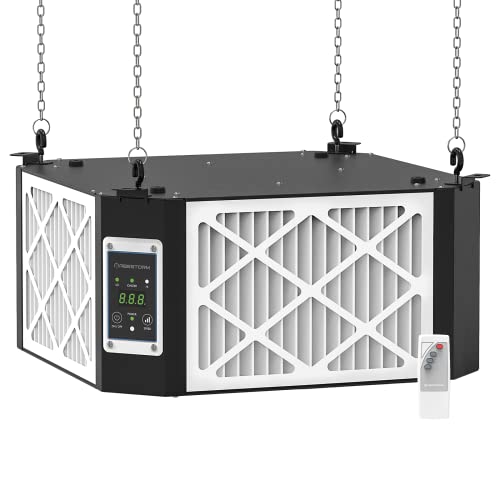


As an Amazon Associate we earn from qualifying purchases at no extra cost to you. Ratings are shown as listed on Amazon.
Spec Comparison: Popular Ceiling-Mounted Air Filtration Systems
All units below are three-speed, timer-controlled hanging units designed for woodworking and general workshop use. Specs are based on current 2026 manufacturer data for standard 120V models.
| Model | Airflow (CFM) Low / Med / High | Filter System | Coverage Area (8 ft ceiling) | Noise Level (dB) Low-High | Weight | Mounting |
|---|---|---|---|---|---|---|
| JET AFS-1000B | 450 / 650 / 1044 | 5-micron outer, 1-micron inner reusable electrostatic | Up to 1,000 sq ft | 60 – 68 | 71 lbs | Ceiling hanging with 4 eye bolts or wall bracket; 11A draw |
| Powermatic PM1200 | 325 / 500 / 1200 | 5-micron outer, 1-micron inner electrostatic, activated carbon secondary | Up to 1,200 sq ft | 62 – 71 | 82 lbs | Ceiling hanging only; 3 eye bolts; 7.5A draw |
| WEN 3410 (3-Speed) | 300 / 350 / 400 | 5-micron outer, 1-micron inner | Up to 400 sq ft | 55 – 63 | 32 lbs | Ceiling hanging or vertical; 4 eye bolts or screw hooks |
| WEN 3417 (Remote/Heavy Duty) | 400 / 500 / 556 | 5-micron outer, 1-micron inner | Up to 550 sq ft | 58 – 65 | 42 lbs | Ceiling hanging; includes eyebolts and brackets |
| Rikon 62-400 | 430 / 580 / 850 | 5-micron outer, 1-micron inner | Up to 850 sq ft | 61 – 69 | 68 lbs | Ceiling hanging; 4 eye bolts; requires joist anchoring |
| Grizzly G0572 | 260 / 362 / 450 | 5-micron outer, 1-micron inner | Up to 450 sq ft | 57 – 64 | 47 lbs | Ceiling hanging; 4 chains; low ceiling clearance option |
CFM and noise figures are manufacturer rated at high speed without ducting. Real-world CFM drops 10-15% as filters load. Coverage area assumes a standard 8-foot ceiling and target of 6-8 air changes per hour, which is the common baseline for woodworking shops.
Decision Matrix: Match the System to Your Shop
Use your shop size, typical dust load, and where you can mount to narrow the field quickly:
| Your Situation | What Matters Most | Best Fit Type |
|---|---|---|
| 1-car garage / small basement shop (200-400 sq ft), hobby use 4-8 hrs/week, mostly hand tools or small power tools | Low noise, light weight, easy mounting on single joist | WEN 3410 or Grizzly G0572. Lower CFM is sufficient, weight under 50 lbs means no reinforcement. |
| 2-car garage (400-650 sq ft), table saw, planer, router used regularly | Mid-range CFM (500-600), 1-micron inner filter, timer for after-work clearing | WEN 3417 or Rikon 62-400. Balance of airflow and noise without 80+ lb weight. |
| Large dedicated shop (800-1,200 sq ft), daily use, heavy dust producers like sanding stations and CNC | High CFM (800+), dual or electrostatic filtration, RF remote | JET AFS-1000B or Powermatic PM1200. Higher draw and weight require solid joist or truss mounting. |
| Low ceiling (under 7.5 ft) or finished ceiling with drywall | Low profile, vibration control, limited hanging depth | WEN 3410 or Grizzly G0572 with hanging chains cut short and rubber isolation mounts to reduce rattle. |
| Shared or attached garage where noise matters | dB under 65 on medium, multiple timer settings | JET AFS-1000B on low/medium (60-65 dB) or WEN 3410. Avoid running any unit on high continuously if noise is a concern. |
How to Calculate Coverage: Do You Need One or Two Units?
Do not rely only on the “up to X sq ft” on the box. Calculate air changes per hour (ACH) for your actual volume. For fine dust control, aim for 6 to 8 ACH when the system is running.
Formula: ACH = (CFM x 60) / Shop Volume in cubic feet
Shop Volume = Length x Width x Height
Worked Example
Shop: 20 ft x 22 ft x 8 ft = 3,520 cubic feet
- Single JET AFS-1000B on medium (650 CFM): (650 x 60) / 3,520 = 11.07 ACH – Excellent, well above target. You can run on medium and stay quieter.
- Single WEN 3410 on high (400 CFM): (400 x 60) / 3,520 = 6.82 ACH – Meets the minimum, but must run on high continuously, which is louder and wears filters faster.
- Single Powermatic PM1200 on high (1200 CFM): (1200 x 60) / 3,520 = 20.45 ACH – Overkill for this size; you could run on low (325 CFM = 5.5 ACH) most of the time and boost to high after heavy sanding.
If your calculation is under 6 ACH on high, you either need a higher-CFM unit or two smaller units on opposite ends of the shop. Two units placed diagonally circulate air better than one large unit in the center, especially in L-shaped shops.
Airflow vs. Filter Type: What Actually Affects Air Quality
Three factors determine how well a ceiling unit clears fine dust:
1. CFM and Speed Settings
All listed units have three speeds. Use low for background filtration while you work, high for 30-60 minutes after you stop to clear suspended particles. Units with RF remotes (JET, Powermatic, WEN 3417) let you change speed without climbing, which matters because you should leave the unit running after you leave the shop.
2. Two-Stage Filtration
The standard setup is a 5-micron washable outer filter that catches large chips and an inner 1-micron filter for the respirable fraction. JET and Powermatic use a reusable electrostatic inner filter that can be blown out with compressed air several times before replacement. WEN, Rikon, and Grizzly use pleated paper-style 1-micron inner filters that must be replaced, not washed. Electrostatic filters cost more initially but reduce long-term consumable cost if you have compressed air to maintain them correctly.
3. Timer and Circulation
Look for 1, 2, and 4-hour timer options. A unit that automatically runs for an hour after you leave clears the lingering cloud you cannot see. Powermatic and JET include 2 and 4-hour settings; WEN models include 1, 2, and 4 hours as well. For shops over 600 sq ft, a second small circulation fan on the floor helps push dust up toward the intake, improving effective ACH without buying a second filtration unit.
Noise and Mounting Requirements
Noise is measured in dB at 5 feet. A jump from 63 dB to 69 dB is perceived as nearly twice as loud. If you work in the shop with the filter running, medium-speed noise is the realistic number to plan around, not low.
- Weight and joists: Units over 65 lbs (JET, Powermatic, Rikon) must be lag-bolted directly into joists or trusses, not drywall anchors. Use 3/8-inch eye lags with at least 2 inches of thread in solid wood. For truss ceilings, span two trusses with a 2×6 cleat and hang from the cleat.
- Vibration: Hang with chain or threaded rod plus rubber isolators or springs. Rigid screw hooks transmit vibration to drywall and increase noise. Leave at least 12 inches of clearance from the ceiling to the top of the unit for intake.
- Height: Mount 7 to 8 feet from the floor. Too high reduces capture of the breathing zone dust; too low puts it in the way of sheet goods and lights. Most manufacturers recommend the bottom of the unit no lower than 6.5 feet.
- Power: All six models run on standard 120V/15A outlets. Avoid extension cords if possible. If you must use one, use a 14-gauge cord under 10 feet. Units draw 3A to 11A on startup.
- Placement: Center the intake along the long axis of the shop, exhaust pointed toward your main dust-producing tools. Do not mount directly above a dust collector exhaust or heater, which disrupts the circular airflow pattern.
Durability and Ownership Realities
Ceiling units are simple mechanically, but failures follow a predictable pattern:
- What wears first: The outer 5-micron filter clogs fastest, typically every 40-80 hours of shop time. The motor capacitor and remote receiver are the next most common failure points after 3-5 years in dusty environments. Keep the receiver window dust-free.
- Consumables: Inner 1-micron filters last 6-12 months with regular outer filter cleaning, less with heavy MDF sanding. Replacement inner filters generally cost $35 to $75 depending on model; outer filters $18 to $40. Electrostatic filters can be cleaned 3-5 times with low-pressure compressed air (30 PSI max, outside the shop) before fiber breakdown reduces efficiency.
- Cleaning routine: Vacuum the outer filter weekly if you use the shop 10+ hours. Do not wash paper pleated inner filters. Do not blow out inner filters indoors – you will re-aerosolize fine dust. Check chains and eye bolts every 6 months for loosening from vibration.
- Common mistakes: Running without the outer filter to increase airflow destroys the inner filter in weeks. Mounting flush to the ceiling chokes intake by up to 30%. Leaving the unit off after work defeats the purpose; fine dust stays airborne for 30 minutes to several hours after cutting stops.
- When to replace vs. clean: If light no longer passes through the outer filter after vacuuming, or if CFM on high feels weak with clean filters and open intake, the inner filter is loaded and needs replacement. A simple test is a tissue held to the exhaust – it should stick firmly on high. If it falls, airflow is compromised.
For general respiratory health, ceiling filtration reduces but does not eliminate exposure to fine wood dust. Continue using source capture at the tool and a properly fitted respirator for sanding and routing operations, and consult a professional if you have respiratory sensitivities.
Which Model Should You Buy?
If you want the best all-around value for a 2-car garage with moderate noise, the JET AFS-1000B and Rikon 62-400 offer the best CFM-per-dollar and washable inner filter options, with the JET edging ahead on airflow at 1044 CFM. For small shops where weight and noise dominate the decision, the WEN 3410 at 32 lbs and 55 dB on low is easier to install and live with, even though you sacrifice top-end CFM. For large or professional shops running daily, the Powermatic PM1200 justifies its higher weight and price with 1200 CFM on high and a more sophisticated timer and filtration stack designed for continuous duty.
Match your cubic footage first, then filter type, then mounting limits. A correctly sized and placed 400 CFM unit will outperform an oversized unit mounted in a corner against the ceiling every time.