Key takeaways
- Its long-range sensitivity can produce more alerts around automatic door openers and vehicle-safety systems unless settings and GPS lockouts are tuned.
- Directional information is most useful when the detector has a clear view through the windshield; heavily tinted or metallic windshields can reduce performance.
- Use the detector’s regional and city settings rather than simply turning sensitivity to maximum everywhere.
The best radar detectors for most drivers are the Uniden R8 for long-range, directional coverage, the Escort MAX 360 MKII for polished GPS filtering and an approachable interface, and the Valentine One Gen2 for drivers who value precise arrows and deep customization over built-in convenience features.
A radar detector cannot identify every traffic-enforcement method, and local laws may restrict or prohibit their use. It is a driver aid, not permission to speed: keep your attention on the road, follow posted limits, and check the rules where you drive.
Our top picks


As an Amazon Associate we earn from qualifying purchases at no extra cost to you. Ratings are shown as listed on Amazon.
Best radar detectors by driving situation
| Driver situation | Best fit | Why it fits | Typical market range |
|---|---|---|---|
| Maximum range on highways | Uniden R8 | Strong long-range performance, front and rear antennas, directional arrows, GPS, and broad band support | $550–$700 |
| Best balance of automation and ease of use | Escort MAX 360 MKII | Directional alerts, GPS lockouts, a mature companion app, and a relatively simple interface | $600–$800 |
| Enthusiast who wants maximum control | Valentine One Gen2 | Excellent directional information and configurable behavior through its app ecosystem | $500–$600, before optional accessories |
| Lower-cost long-range option | Uniden R4 | Front-facing long-range detection and GPS features without the price of a directional flagship | $300–$450 |
| Frequent driver who wants a connected system | Escort Redline 360c | Directional coverage, GPS filtering, Wi-Fi updates, and strong automation | $700–$900 |
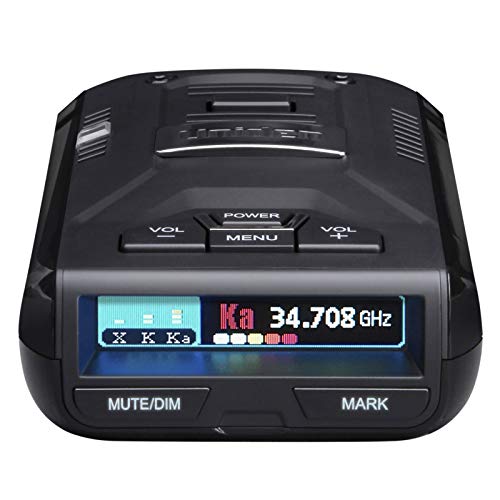
Uniden R8: best radar detector for maximum directional range
The Uniden R8 is the strongest choice when detection distance and situational awareness matter more than a compact body or a low price. It uses front and rear radar antennas, so its arrows can indicate whether a signal is ahead, behind, or to the side. That is more useful than a simple alert: a rear-facing signal that remains behind you suggests a different situation from a source that moves from ahead to beside you.
It covers the common X, K, and Ka radar bands, along with laser alerts, and provides GPS-based features such as marked locations and speed-sensitive behavior. Its OLED display can show band, signal strength, direction, and multiple threats. The trade-off is size. At roughly 4.5 inches wide and around 8 ounces, it needs more windshield or dashboard space than a basic detector.
What to know before buying
- Its long-range sensitivity can produce more alerts around automatic door openers and vehicle-safety systems unless settings and GPS lockouts are tuned.
- Directional information is most useful when the detector has a clear view through the windshield; heavily tinted or metallic windshields can reduce performance.
- Use the detector’s regional and city settings rather than simply turning sensitivity to maximum everywhere.
Escort MAX 360 MKII: best for filtering and everyday usability
The Escort MAX 360 MKII is a better match for drivers who want strong protection without constantly adjusting advanced settings. It combines front, rear, and side awareness with a clear directional display. Its GPS database and lockout system can learn recurring stationary signals, such as supermarket doors and automatic toll equipment, reducing nuisance alerts on familiar routes.
Escort’s connected features are part of the appeal. Depending on the subscription and phone setup, the companion ecosystem can provide shared alerts, software updates, and cloud-based information. That makes it especially useful for commuters who drive the same roads repeatedly. The main ownership consideration is that some connected features may require a paid plan, while the core radar-detection function does not depend on a subscription.
The MAX 360 MKII is also a sensible choice for a first premium detector. Its filtering is less dependent on manually editing dozens of band settings, and the voice prompts make it easier to understand an alert without looking down. It usually costs more than a non-directional Uniden, but the reduction in false alarms can be worth more than a small advantage in raw sensitivity for daily city driving.
Valentine One Gen2: best for drivers who want arrows and control
The Valentine One Gen2 remains distinctive because it presents threats with front, rear, and side direction information and reports the number of signals detected. Its behavior can be configured through compatible smartphone software, allowing experienced users to tailor sensitivity, muting, and display choices.
This is not the most turnkey option. The detector itself is relatively compact—about 4 inches wide and roughly 6 ounces—but its full feature set depends on a phone or third-party app. GPS lockouts, route-based muting, and customized displays are therefore more dependent on setup than on the detector alone. Drivers who want a self-contained screen and built-in database may prefer the Escort or Uniden alternatives.
Uniden R4: the value pick for highway commuters
The Uniden R4 offers much of the long-range appeal associated with Uniden’s higher-end models, but it uses a front-facing antenna rather than the R8’s front-and-rear directional arrangement. That makes it a strong value when your priority is warning distance on highways and open roads, not identifying the precise direction of every signal.
It supports GPS-based lockouts and common radar bands, and its relatively compact body fits more easily behind a rear-view mirror. The missing rear antenna matters most in traffic: an R4 can warn you about a signal behind you, but it cannot provide the same directional certainty as a true dual-antenna detector. For many drivers, that is an acceptable compromise for a saving of roughly $200 or more.
How the important features compare
| Feature | Uniden R8 | Escort MAX 360 MKII | Valentine One Gen2 | Uniden R4 |
|---|---|---|---|---|
| Front/rear radar antennas | Yes | Yes | Yes | No; front-facing design |
| Directional alerts | Front, rear, and side indications | Front, rear, and side indications | Front, rear, and side indications | Limited compared with dual-antenna models |
| GPS lockouts | Built in | Built in; connected database features available | App-dependent | Built in |
| Common radar bands | X, K, Ka, plus laser alerts | X, K, Ka, plus laser alerts | X, K, Ka, plus laser alerts | X, K, Ka, plus laser alerts |
| Approximate detector width | 4.5 in | 3.5–4 in | About 4 in | About 3.5 in |
| Best mounting advantage | Clear view for long-range front/rear coverage | Compact windshield installation | Compact body; excellent app customization | Small windshield footprint |
Dimensions and included accessories can vary slightly by revision and package. The figures above are practical size estimates for installation planning, not a substitute for the manufacturer’s current specifications.
Radar-band performance: what changes in real driving
Ka band
Ka band is the primary priority for many highway users because it is widely associated with police radar. A good detector should provide useful range while filtering legitimate sources. Do not disable Ka simply to reduce false alerts.
K band
K band is more complicated. It can be used for enforcement, but it is also common in blind-spot monitoring and vehicle-safety systems. City driving may therefore produce frequent alerts. GPS lockouts help with stationary sources, while frequency-based filtering can reduce some vehicle-system alerts, but excessive filtering can remove legitimate warnings.
X band and laser
X band is less common in many areas but still exists, so disabling it should be a local decision based on reliable knowledge of enforcement practices. Laser alerts provide little reaction time and can be affected by weather, vehicle position, and targeting conditions. Treat a laser alert as urgent information, not as a guarantee that the detector can provide advance warning.
Windshield mounting and setup that prevent avoidable problems
- Mount high but below the tint band. Place the detector near the center of the windshield with a clear forward view. Avoid a position behind wiper obstruction, metallic tint, or a dash-mounted screen that blocks the antenna.
- Keep it level. Radar antennas are designed around a consistent orientation. A sharply tilted detector can reduce useful coverage, especially on roads with elevation changes.
- Use a switched power source. A 12-volt accessory socket is simple, while a properly installed hardwire kit can hide the cable and provide automatic startup. Do not leave the unit powered indefinitely if the vehicle’s outlet remains live.
- Update firmware and databases. Firmware can improve filtering and resolve bugs; GPS databases become more useful as you drive and mark recurring false-alert locations.
- Learn before changing advanced settings. Start with the manufacturer’s default highway or city profile, then adjust one setting at a time. This makes it easier to identify whether a change removed nuisance alerts or important coverage.
Ownership realities and common mistakes
The suction-cup mount usually wears out before the detector. Heat, sunlight, and repeated removal can weaken the cup and make the unit fall. Clean both the glass and the cup with a suitable glass cleaner, inspect the cable periodically, and replace the mount if it no longer holds securely. Never allow the detector to become a projectile in a collision.
False-alert filtering also requires patience. A GPS lockout should be created only after confirming that a location repeatedly produces the same stationary signal. Automatically locking out every alert on a familiar road can hide a real enforcement source later. Keep the detector firmware current, but remember that updates do not replace good judgment about local bands and enforcement methods.
Bottom line
Choose the Uniden R8 when maximum range and directional information are the priority. Choose the Escort MAX 360 MKII for the most approachable combination of arrows, GPS lockouts, and connected features. Choose the Valentine One Gen2 if you enjoy configuring an app-based system and want exceptionally clear threat direction. For a smaller budget, the Uniden R4 delivers a strong highway-focused package, provided you can live without rear-antenna direction finding.