Key takeaways
- Compare the best dash cams for front and rear coverage, with 4K video, GPS logging, cabin channels and parking modes from Viofo, Vantrue and Thinkware.
A dash cam is the one accessory that pays off on the worst day of car ownership: the disputed lane change, the parking-lot scrape nobody admits to, the insurance claim that turns into your word against theirs. Modern cameras record 4K video up front, watch the road behind you, log GPS speed and position, and keep guarding the car after you walk away. This guide compares five dual and triple-channel models sold on Amazon, from balanced front-and-rear kits to three-channel systems built for rideshare work and a radar-equipped parking specialist, so you can match the coverage to the way you actually use your car.
As an Amazon Associate, we earn from qualifying purchases.
Quick answer
Start with the Viofo A229 Pro 2CH: genuine 4K front video, a 2K rear camera, STARVIS 2 sensors at both ends, GPS logging and fast Wi-Fi in one kit. Drivers who carry passengers should consider the three-channel Viofo A229 Pro 3CH or Vantrue N4 Pro S, the Vantrue N4 covers three channels on a simpler design, and the Thinkware U3000 is the pick when parked-car protection matters most.
Viofo A229 Pro 4K HDR Dash Cam Front and Rear
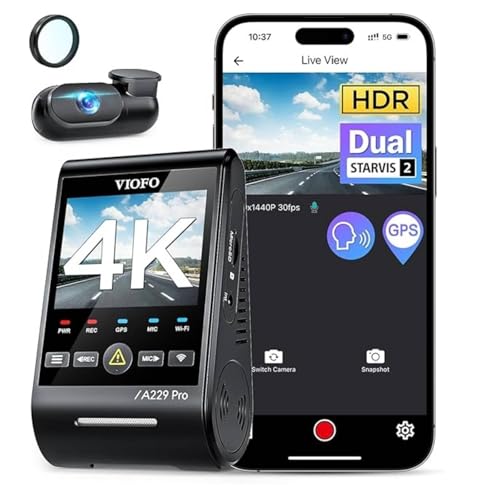
The A229 Pro 2CH is the balanced choice for owners who want strong evidence in both directions without flagship pricing. The front camera records 4K with HDR through a Sony STARVIS 2 IMX678 sensor, and the rear camera records 2K on a STARVIS 2 IMX675 sensor, a pairing that keeps plates legible after dark at both ends of the car. Built-in GPS stamps speed and route data onto the footage, and 5GHz Wi-Fi transfers clips to a phone noticeably faster than the 2.4GHz radios still fitted to budget cameras. Voice control covers routine commands such as locking a clip, so your hands stay on the wheel. Hardwired, the parking mode watches for 24 hours with buffered recording on supported setups. The wedge-shaped body tucks high behind the mirror and stays out of your sightline. Pick this one if you drive a single car every day and want the front-and-rear pairing most owners wish they had fitted before their first incident. It is also the sensible upgrade from a front-only camera, because the rear channel documents the rear-end collisions a single lens never sees.
Viofo A229 Pro 3CH 4K HDR Dash Cam with Cabin Camera
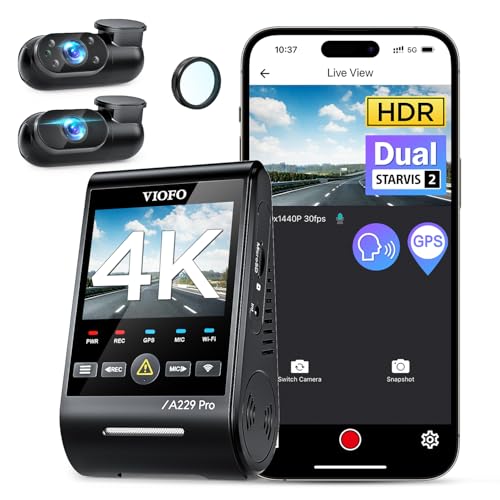
The 3CH version adds an inward-facing cabin camera to the same front-and-rear hardware, recording 4K in front, 2K behind and 1080p inside the car. That third channel is the whole point of this version: rideshare and taxi drivers gain a record of passenger interactions, parents gain oversight of a teen driver, and fleet operators gain a fuller account of any incident. It keeps the dual STARVIS 2 sensors, HDR, GPS logging, 5GHz Wi-Fi and voice control of the two-channel model, and it accepts memory cards up to 512GB, which matters because three streams fill storage quickly. Parking mode again runs around the clock once a hardwire kit is fitted. The cabin camera is built into the main unit rather than a separate pod, so installation stays simpler than three-piece systems, though three simultaneous recordings still demand a high-endurance card. Choose the 3CH if what happens inside the car is part of what you need documented. If it is not, the 2CH above records the road identically, costs less and puts less pressure on storage.
Vantrue N4 Pro S 4K 3 Channel Dash Cam
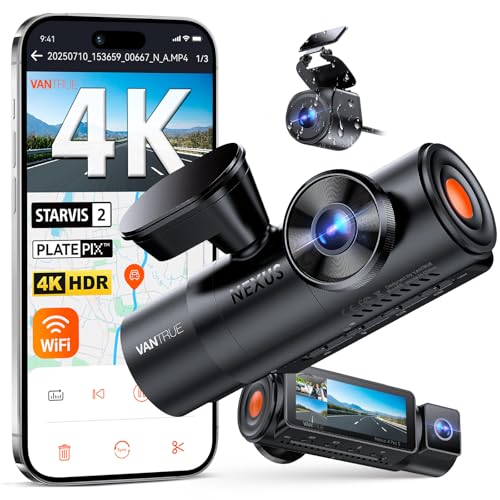
The N4 Pro S is Vantrue’s three-channel flagship, and it carries the strongest rear camera in this group. It records 4K in front, 1080p in the cabin and 2.5K at the rear, with STARVIS 2 sensors on all three channels, HDR, and infrared night vision for the cabin after dark. The rear camera is rated IP67, so it tolerates exterior mounting and wet weather better than interior-only rear units, a real advantage on trucks and SUVs where a rear window mount is awkward. Voice control, GPS and Wi-Fi are built in, parking mode watches the car while it sits, and the camera accepts memory cards up to 1TB, the largest ceiling here, which suits long shifts between downloads. A hardwire kit is required to run the full parking mode, as with most cameras in this class. This is the pick for rideshare drivers who work nights, because the infrared cabin view and the higher-resolution rear channel both address the situations that generate disputes. Drivers who never carry passengers can choose a two-channel model instead and lose nothing on road coverage.
Vantrue N4 3 Channel Dash Cam
The original N4 remains a sound triple-channel buy for drivers who want front, cabin and rear coverage without the newest sensor generation. It records 1440p at the front, 1440p in the cabin and 1080p at the rear, or a sharper 4K front channel paired with a 1080p rear camera in dual-channel mode. Infrared lights handle the cabin at night, and a supercapacitor replaces the lithium battery, the right engineering call for a device that bakes on a windshield all summer and freezes all winter. Parking mode watches for motion and impacts for 24 hours with the hardwire kit fitted, and the camera supports cards up to 256GB. GPS is an optional mount rather than a built-in feature on this model, so drivers who want speed and route logging should budget for the GPS mount or step up to one of the Viofo models above. Pick the N4 if three-channel coverage matters more than the highest front resolution and you prefer a proven, simpler design. It also makes a reasonable camera for a second car, where the flagship models are harder to justify.
Thinkware U3000 4K Dash Cam Front and Rear

The U3000 is the parking-protection specialist of this group. The front camera records 4K and the rear camera 2K, both on STARVIS 2 sensors with Super Night Vision 4.0 processing for low-light plate capture. Its headline feature is radar-based buffered parking mode: a built-in radar sensor watches for movement near the car while drawing very little power, then saves buffered video around an impact, which stretches parked coverage far beyond what motion detection alone can sustain. Built-in GPS and 5GHz Wi-Fi are standard, red light and speed camera alerts are included, and a CPL filter ships in the box to cut windshield glare. Power comes through an OBD cable or a hardwire lead depending on the bundle, which simplifies installation for owners who would rather not tap the fuse box. Choose the U3000 if your car spends its nights on the street or in shared lots and parking incidents are the main worry. Drivers who garage the car nightly and mainly need road footage will get equivalent driving video from the Viofo models for less.
How to choose
Start with channel count. A front-only camera misses rear-end impacts entirely, a front-and-rear pair covers the road in both directions, and a cabin channel only earns its cost for rideshare, taxi, fleet or teen-driver use. Next, judge the sensor rather than the resolution headline: STARVIS 2 sensors with HDR hold plate detail at night far better than older sensors recording the same pixel count. Then settle the parking question. Buffered and radar-based modes capture the moments around an impact, but every always-on mode needs a hardwire kit or OBD power and a camera with modest draw. Check storage support too, because three high-resolution channels can fill a small card within days, and high-endurance cards are the correct pairing. Finally, before ordering any model, check the exact model number against the CPSC recall database, and favour supercapacitor designs if the car lives in extreme heat, since capacitors tolerate temperature swings that shorten lithium battery life.
Who should skip
Skip a dash cam if your car already records through a factory surround-view system whose footage you can export, or if the rules where you drive restrict windshield-mounted devices or cabin audio recording. Skip the three-channel models if you never carry passengers for work, because the cabin camera adds cost, wiring and storage load you will never use. Skip radar parking systems if the car is garaged every night, since the feature solves a problem you do not have. And skip the category entirely if you are unwilling to hardwire the camera or manage a memory card, because a camera that sits unplugged or full records nothing at all.
Frequently asked questions
Do these dash cams record while the car is parked?
Yes, provided the power supply is right. Parking mode needs a hardwire kit or an OBD power cable so the camera can draw power with the engine off; it then records on motion or impact, and radar-based systems such as the Thinkware U3000 stand watch at far lower draw. Running parking mode from the 12-volt socket alone usually ends when the car goes to sleep.
What memory card size do I need?
Match the card to the channel count. A two-channel 4K setup runs comfortably on a high-endurance card in the middle of its supported range, while three-channel systems that accept 512GB or 1TB cards benefit from the extra headroom on long trips. Loop recording overwrites the oldest footage, so a larger card simply keeps more days of driving before it cycles.
Is a cabin camera worth it?
Only for specific drivers. Rideshare, taxi and delivery drivers gain a record of passenger interactions, and parents of new drivers gain oversight. For a solo commuter, the cabin channel adds cost, storage use and privacy questions with no real benefit, while a front-and-rear pair covers every road incident that matters for a claim.
Will a dash cam drain my car battery?
A hardwired camera in parking mode draws a small continuous current. Hardwire kits include low-voltage cutoffs that stop the camera before the battery falls too far, and radar-based parking modes draw much less than constant recording. Cars driven daily rarely notice the load; a car parked for weeks at a time is the case that needs watching.
Final verdict
Buy the Viofo A229 Pro 2CH for the strongest all-round front-and-rear package, or its 3CH sibling when the cabin needs covering as well. Choose the Vantrue N4 Pro S for night rideshare work and the largest storage ceiling, the Vantrue N4 for proven three-channel coverage on a simpler design, and the Thinkware U3000 when parked-car protection is the priority. Any of the five turns a disputed incident from an argument into a file you can hand over.
Product and ASIN Reference
| Product | ASIN |
|---|---|
| Viofo A229 Pro 4K HDR Dash Cam Front and Rear | B0CKYFSKNN |
| Viofo A229 Pro 3CH 4K HDR Dash Cam with Cabin Camera | B0CKYGLT5M |
| Vantrue N4 Pro S 4K 3 Channel Dash Cam | B0F8BQW4TR |
| Vantrue N4 3 Channel Dash Cam | B083V6K8RH |
| Thinkware U3000 4K Dash Cam Front and Rear | B0BTWKS836 |
More from Amazon
Programs that pair well with the guide above. Offers and eligibility are set by Amazon and may change.
Free shipping on eligible items, Prime Video and more. Eligible new members can start with a free trial.
Start a Prime free trialAudiobooks and podcasts to listen to on the go. Eligible new members can start with a free trial.
Try Audible freeAd-free music streaming. Eligible new subscribers can start with a free trial.
Try Music Unlimited freeA free business account with business pricing and bulk-buying tools for work, shop or home office.
Create a business accountAs an Amazon Associate we earn from qualifying purchases.