Key takeaways
- Compare the best car dryers and blowers for touch-free drying, from dual-motor canister dryers to compact handheld blowers with filtered warm air.
Drying is where careful washing often goes wrong: a towel dragged over a panel that still carries a film of grit can undo an hour of gentle work. A dedicated car dryer removes most of the water with filtered, heated air instead, sheeting water off flat panels and blasting it out of mirrors, badges, door jambs, and wheel spokes where towels cannot reach. This guide compares five electric dryers across the main formats, from a dual-motor canister flagship to a compact handheld blower, with notes on airflow, hose length, filtration, and noise so you can match the tool to your garage and routine.
As an Amazon Associate, we earn from qualifying purchases.
Quick answer
The Adam’s Polishes Air Cannon is the strongest all-round pick for whole-car drying, with dual motors, filtered heated air, and a long self-expanding hose. The Metrovac Master Blaster is the heavy-duty steel alternative, the Mini Air Cannon suits small cars and spot drying, the Chemical Guys ProBlow is a simple handheld for quick jobs, and the Shelandy dryer adds wheels and a heater at a value-oriented position.
Adam’s Polishes Air Cannon Car Dryer Blower
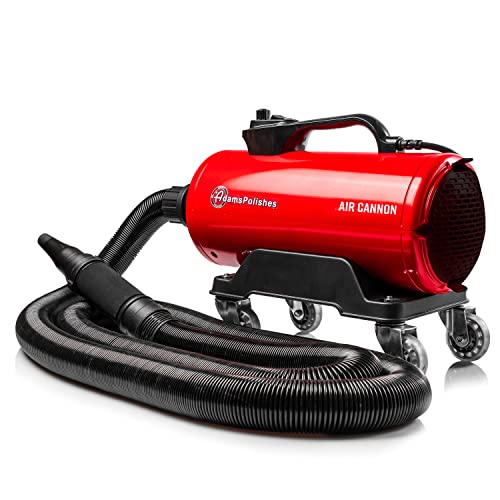
The full-size Air Cannon is built around the canister format that serious home detailers tend to settle on. Two motors move a high volume of air through a filter, and the air warms as it passes through the unit, which helps water evaporate rather than just relocate. Adam’s rates the output at 392 CFM with air speeds that sheet water off horizontal panels in long passes. The standout practical feature is the hose: it self-expands to about thirty feet when running and retracts for storage, so the canister can stay parked while you walk the full length of a truck or SUV. Rubberized attachments, including fan and pointed tips, protect trim if a nozzle brushes the paint. The unit is not quiet, at a rated 84 dB, so early-morning use in a dense neighborhood deserves consideration. Filtration is the other reason to choose this format over a leaf blower: the intake filter keeps dust and grit out of the airstream, which matters when the whole point is avoiding contact with the paint. For regular whole-vehicle drying in a fixed garage, this is the most complete package in the group.
Metrovac Air Force Master Blaster MB-3 Car Dryer

Metrovac has built forced-air dryers in the United States for decades, and the Master Blaster MB-3 is its flagship automotive format: a steel canister housing twin two-stage motors rated at 4.0 peak horsepower each. The combined output moves air at up to about 58,000 feet per minute, enough to strip water from a full-size vehicle quickly and to clear standing water from engine bays and door jambs. A ten-foot commercial-grade hose and a set of attachments, including a blower nozzle and a crevice-style tip, come in the box, and the steel body shrugs off the knocks of a working garage better than plastic housings. The air is filtered and warms through the motors, supporting spot-free drying on dark paint. Trade-offs are size, weight, and noise: this is a tool you wheel or carry to the car rather than hold, and the twin motors draw serious current, so a healthy garage circuit matters. There is no heat control beyond the warmth the motors generate. For owners who dry multiple vehicles, motorcycles, or boats and want a serviceable, long-life machine, the Master Blaster remains the category’s durability benchmark.
Adam’s Polishes Mini Air Cannon Handheld Dryer

The Mini Air Cannon shrinks the filtered-air concept into a handheld unit of about four and a half pounds that you carry around the car instead of trailing a hose. It uses a single motor with a filter, pushing warm air at a rated 19,000 feet per minute and about 90 CFM, which is plenty for chasing water out of mirrors, grilles, fuel doors, and wheel faces, and workable for drying a small car panel by panel. Rubberized nozzle attachments reduce the risk of a hard edge touching paint during close work. Because the whole unit is in your hand, it is the easiest of the five to grab for quick jobs: drying a motorcycle, clearing a convertible top’s seams, or finishing edges after a towel pass on the main panels. The limits are reach and pace on large vehicles, where a canister and hose cover ground faster, and runtime comfort, since holding any blower at arm’s length for a full SUV eventually tires the wrist. As a second dryer beside a towel routine, or the only dryer for a compact car kept in a small garage, it earns its place.
Chemical Guys ProBlow High Flow Professional Hand Held Dryer and Blower

The ProBlow is Chemical Guys’ handheld entry, model EQP403, built around a 1000-watt motor and a simple brief: move enough air to dry a car without dragging out a canister. It ships with nozzle attachments that concentrate the stream for seams and badges or spread it for panels, and the compact body doubles as a general blower for the garage, clearing dust from workbenches, blowing out the interior footwells before vacuuming, and drying yard tools. That dual role is the honest reason to pick it over the more specialized handheld above: it is a utility blower that also dries cars. The air is not marketed as filtered to the same degree as the Adam’s units, so it suits daily drivers and work vehicles better than freshly coated show cars. Speed control is basic compared with canister dryers, and drying a large SUV is a longer job than with the dual-motor machines. For apartment dwellers and occasional washers who want one tool that dries the car on Saturday and clears the patio on Sunday, the ProBlow covers both jobs in a small footprint.
Shelandy Powerful Motorcycle and Car Dryer
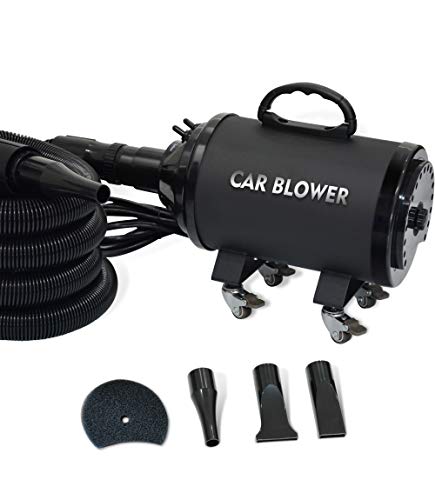
The Shelandy dryer takes the wheeled canister format and aims it at value. A 2800-watt motor with a separate 600-watt heater element gives it adjustable airflow, rated from about 65 to 135 MPH, plus switchable heat, a combination usually found on grooming-style force dryers. It rides on wheels and connects through a fourteen-foot flexible hose, with a sixteen-foot power cord, so total working reach around a vehicle is generous without moving the unit. Nozzle attachments handle the usual mirror, jamb, and spoke work, with flat and concentrated tips for panels and tight crevices. The heater is the differentiator in cold garages, where warm air noticeably speeds evaporation and keeps hands comfortable, though heat settings should be kept moderate around fresh wax and delicate trim. At a rated 75 dB it is not the quietest here, and the housing is plastic rather than steel, so it rewards careful storage. Buyers who dry cars, motorcycles, and larger pets with the same machine will appreciate the format most. For the price class, the blend of wheels, hose length, and real heat is difficult to match.
How to choose
Decide first between handheld and canister formats. Handheld dryers are light, store anywhere, and excel at detail areas, but they slow down on large vehicles. Canister dryers with long hoses cover a whole car faster and keep the motor weight off your arm. Next, look at airflow figures rather than motor claims alone: CFM and air speed together describe how much water a dryer sheets off panels, while attachments decide how well it clears mirrors and jambs. Filtration matters if the car wears a coating or soft paint, since unfiltered air can carry garage dust. Heat helps in cold weather and speeds evaporation, but fixed high heat is a drawback around fresh wax. Check cord and hose length against your parking spot, and confirm your garage circuit can handle a twin-motor unit. Noise ratings deserve a glance if you wash early or share walls with neighbors.
Who should skip
Skip a dedicated dryer if you wash infrequently and already dry with a plush towel on a well-waxed daily driver; the towel routine is slower but adequate. Owners without a garage outlet near the wash area will find corded dryers frustrating, and none of these five is cordless. If your only goal is clearing leaves and driveway debris, a yard blower does that job, though it lacks filtration for paint work. And anyone expecting a dryer alone to leave a large SUV bone dry in two minutes should recalibrate: even the strongest units here are usually paired with a quick towel pass on glass and flat panels.
Frequently asked questions
Is a car dryer better than a leaf blower for drying?
For paint, yes. Car dryers filter the intake air, warm it to speed evaporation, and use rubberized nozzles shaped for seams and mirrors. A leaf blower moves plenty of air but can blow unfiltered dust across wet paint and usually has hard plastic tips. Many owners use a blower for wheels and jambs and a dryer for panels.
Will a dryer remove all the water by itself?
On waxed or coated paint, a strong dryer sheets off the great majority of water, leaving mist in seams that evaporates or wipes away in seconds. On neglected paint where water clings flat, expect to follow with a light towel pass. Drying in shade and working panel by panel keeps results consistent either way.
How loud are these dryers in practice?
Ratings in this group run from about 75 to 84 dB, roughly the range of a loud vacuum cleaner. Twin-motor canisters are the loudest. If you wash early in the morning, a handheld at partial throttle for detail areas, or hearing protection for full sessions, keeps the peace with neighbors and your own ears.
Can I use a car dryer on a motorcycle or boat?
Yes, and the format suits them well. Forced air clears water from engine fins, switchgear, chrome, and seating seams where towels snag, and it dries areas that would otherwise drip for hours. Use lower speed and moderate heat around decals, leather, and older rubber seals, and keep the nozzle moving.
Final verdict
Choose the Adam’s Air Cannon for the best balance of power, filtration, and hose reach in a home garage, or the Metrovac Master Blaster if steel construction and twin-motor output top your list. The Mini Air Cannon and ProBlow cover small cars and quick detail work, while the Shelandy adds wheels and switchable heat for buyers who want canister reach at a gentler price. Match the format to your vehicle size and wash frequency, and drying becomes the fastest, safest part of the wash.
More from Amazon
Programs that pair well with the guide above. Offers and eligibility are set by Amazon and may change.
Free shipping on eligible items, Prime Video and more. Eligible new members can start with a free trial.
Start a Prime free trialAudiobooks and podcasts to listen to on the go. Eligible new members can start with a free trial.
Try Audible freeAd-free music streaming. Eligible new subscribers can start with a free trial.
Try Music Unlimited freeA free business account with business pricing and bulk-buying tools for work, shop or home office.
Create a business accountAs an Amazon Associate we earn from qualifying purchases.