Key takeaways
- The mattress usually wears before the frame. Inspect for sagging, broken seams, odor, stains, and compressed edges. A sturdy bed cannot correct a failing mattress.
- Joints loosen with movement. Toddlers may kneel, bounce, or push against the guardrail. Check hardware monthly during the first few months and after relocation.
- Cleaning affects materials. Use a lightly damp cloth on finished wood and dry it promptly. Avoid soaking engineered wood or using abrasive cleaners on painted and plastic surfaces.
- Bedding can change rail performance. Thick quilts and mattress toppers raise the sleeping surface. Use fitted bedding that stays tight and follow the specified mattress thickness.
- Decorative accessories create new risks. Canopies, hanging toys, lights, and attached storage can add cords, climbing points, or protrusions. Keep the sleep area simple.
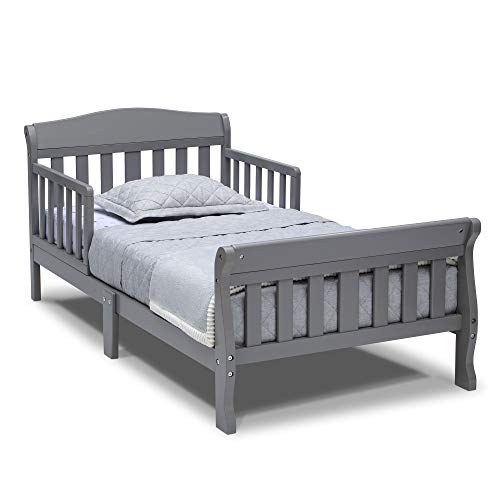
The best toddler beds are low to the floor, fit a standard 28-by-52-inch crib mattress, have guardrails that rise at least 5 inches above the mattress, and leave enough room for a child to get in and out without climbing over bulky sides.
Our top picks


As an Amazon Associate we earn from qualifying purchases at no extra cost to you. Ratings are shown as listed on Amazon.
Best toddler beds by situation
| Situation | Best choice | Why it fits | Main compromise |
|---|---|---|---|
| Small bedroom | Compact low-profile toddler bed | Usually about 54–56 inches long and 29–30 inches wide | Less usable storage and a shorter service life |
| Child who rolls or moves a lot | Bed with two full-length guardrails | More continuous side protection than a single partial rail | Can make independent entry slightly harder |
| Reuse of an existing crib mattress | Standard-size toddler bed | Accepts a 28-by-52-inch mattress without buying a new one | Older mattresses may be worn, stained, or too soft |
| Frequent moves or grandparents’ house | Lightweight wood or steel-frame model | Often weighs roughly 15–25 pounds and is easier to relocate | May feel less substantial than a heavier solid-wood frame |
| Longest useful life | Convertible crib-to-toddler or full-size system | Uses the existing crib structure or later converts to another bed | Usually costs more and takes more assembly |
What makes the best toddler beds safe and practical?
Mattress compatibility comes first
In the United States, most toddler beds are designed for a standard full-size crib mattress measuring approximately 28 inches wide by 52 inches long. Measure the mattress itself rather than relying on its label. A mattress that is too short can leave a gap at the head or foot, while one that is too narrow can create a hazardous space beside the frame.
The mattress should fit snugly on every side. As a practical check, inspect the gap after placing the mattress in the assembled bed; it should not be large enough for a child’s body to become trapped. Use only the mattress thickness specified by the bed manufacturer, because a thick replacement mattress reduces the amount of guardrail above the sleeping surface.
Do not add a topper, adult bed rail, pillow, or thick mattress pad simply to make the bed softer or taller. Those additions can change the fit and reduce the protective height of the rails. Replace a crib mattress if it is sagging, damaged, damp, or no longer holds its shape.
Guardrail height and access
A useful baseline is a guardrail extending at least 5 inches above the top of the mattress, but the manufacturer’s instructions and applicable safety certification should control the final choice. Look for rails that are firmly integrated into the frame rather than thin fabric panels that rely on tension.
Full-length rails provide more continuous protection, but very tall or enclosed rails may frustrate a newly independent toddler. A sensible design usually has one clear entry opening and a rail that prevents accidental rolling without requiring the child to climb. Check the rail height with your actual mattress installed, not with an empty frame.
Low-to-floor design
A low sleeping surface reduces the distance of a fall and makes it easier for a toddler to climb in and out. Many toddler beds place the mattress roughly 6–12 inches above the floor, although the exact height varies with the mattress and support design. A floor-level Montessori-style frame can be even lower, but it needs careful attention to ventilation, cleaning, and the child’s ability to leave the bed safely.
Low is not automatically better. A frame that sits directly on the floor may collect dust and moisture beneath the mattress. If the design has no ventilation clearance, lift and air the mattress periodically according to the manufacturer’s instructions. Avoid placing the bed beside cords, window blinds, heaters, shelves, or furniture that a child could use to climb.
Head-to-head: common toddler-bed designs
Classic raised-frame toddler bed
This is the most straightforward option: a small wood, engineered-wood, or metal frame with a mattress platform and one or two guardrails. It is usually the easiest choice when the crib mattress is still in good condition. Assembly commonly involves attaching side rails, end panels, and the mattress support with approximately 10–25 fasteners.
Choose this style when you want a dedicated toddler bed at a moderate general-market price, typically about $60–$180. Inspect the underside of the support after assembly; widely spaced slats can allow movement or sagging if they are not designed for the mattress.
Convertible crib-to-toddler bed
A convertible crib can be economical when its toddler conversion kit is included or readily available. The advantage is familiar materials and a frame that may later become a daybed or full-size bed. The disadvantage is that conversion often requires removing panels, relocating hardware, and storing unused parts.
Before choosing this route, confirm the exact crib model, conversion instructions, and whether a separate kit is required. Do not improvise with generic brackets. A bed that needs a replacement kit can become more expensive than a simple toddler frame.
Floor-level or Montessori-style bed
This design emphasizes child access rather than enclosure. It can suit a toddler who is ready to leave bed independently and a room with a carefully childproofed perimeter. Select one with smooth, rounded edges, a stable footprint, and enough mattress ventilation.
It is less suitable when the room contains hazards within reach or when adults need a clearly defined barrier. Because the child can walk away immediately, the room—not just the bed—must be prepared for unsupervised nighttime movement.
Themed plastic or character bed
Plastic beds can be light, wipeable, and appealing to children. They are often convenient for temporary use, but check the base carefully for flexing, cracks, and the manufacturer’s weight limit. Molded decorative parts can also create cleaning gaps. Choose a plain, sturdy frame instead if durability and later resale or reuse matter more than appearance.
Materials, assembly, and room fit
Solid wood generally tolerates repeated tightening and minor knocks well, while engineered wood can be perfectly adequate if its joints are reinforced and protected from moisture. Powder-coated steel frames are often light and easy to wipe, but exposed edges, loose caps, or sharp fasteners are unacceptable. Regardless of material, run a hand over every accessible edge after assembly.
Measure the room before ordering. A typical toddler bed occupies about 56–58 inches in length and 29–32 inches in width once the frame is included. Leave at least 24 inches of clear walking space on the usable entry side; more is helpful if the child changes clothes or plays beside the bed. In a small room, a plain rectangular bed usually uses space more efficiently than a sleigh-shaped or canopy design.
Assembly quality matters more than a quick build time. Assemble the frame on a level floor, loosely fit all bolts first, square the frame, and then tighten them in stages. This prevents a twisted rail from making the mattress platform uneven. Recheck every fastener after several nights and whenever the bed is moved. Never substitute screws or hardware of a different length.
Ownership realities parents often miss
- The mattress usually wears before the frame. Inspect for sagging, broken seams, odor, stains, and compressed edges. A sturdy bed cannot correct a failing mattress.
- Joints loosen with movement. Toddlers may kneel, bounce, or push against the guardrail. Check hardware monthly during the first few months and after relocation.
- Cleaning affects materials. Use a lightly damp cloth on finished wood and dry it promptly. Avoid soaking engineered wood or using abrasive cleaners on painted and plastic surfaces.
- Bedding can change rail performance. Thick quilts and mattress toppers raise the sleeping surface. Use fitted bedding that stays tight and follow the specified mattress thickness.
- Decorative accessories create new risks. Canopies, hanging toys, lights, and attached storage can add cords, climbing points, or protrusions. Keep the sleep area simple.
A practical buying formula
Start with the mattress, then the room, then the frame. If your existing mattress is a sound 28-by-52-inch model, select a compatible standard-size bed. If the mattress is questionable, include the cost of a replacement in the budget; a $100 frame plus a $90–$180 mattress can cost more than a better bundled option.
For example, a $120 toddler bed used for three years costs about 11 cents per night before considering the mattress: $120 divided by approximately 1,095 nights. A $220 convertible system used first as a toddler bed and later as a daybed may cost less per year if the later conversion is actually used. The cheapest purchase is not always the lowest ownership cost.
Bottom line
For most families, the best toddler beds are standard-size, low-profile frames with a snug 28-by-52-inch mattress fit, guardrails that remain at least 5 inches above the mattress, stable hardware, and a clear entry opening. Choose a convertible model when its future stages will be used, a floor-level design when the entire room is childproofed, and a compact classic frame when dependable fit and simple assembly matter most.