
Key takeaways
- Casters: lock all casters before anyone climbs. Use only the casters supplied or approved by the maker.
- Moving: push at the base, not the top, and do not move the tower with people or loose materials on the deck. OSHA requires the 2:1 limit while a scaffold is being moved, with exceptions for towers built to recognized stability tests.
- Ground: use level, firm ground or smooth floors. Do not build on slopes, soft soil or loose boards.
- Climbing: use the internal ladder or access system provided, not the cross braces, unless the maker says they are designed for it.
- Electrical hazards: stay well away from overhead power lines. Consult the utility or a qualified electrician before working near live conductors.
- Wind and weather: do not use a tower outdoors in high wind, and follow the maker’s wind guidance.
- Inspection: before each use, look for bent frames, missing pins, damaged decks and worn casters. Remove damaged parts from service.
- Training: a person qualified in scaffold assembly should supervise the build for any regulated job, and local law may require it.
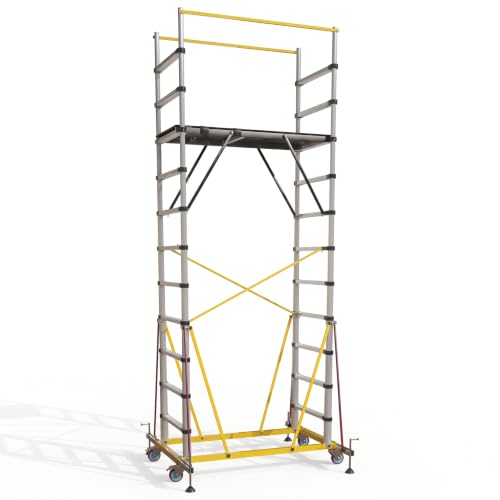
The best rolling scaffold tower for most buyers is a guardrail-equipped, frame-style tower from a maker that lists compliance with the relevant standards, sized so that the working platform stays within the maker’s height-to-base ratio without needing to be tied off. For painting, drywall or ceiling work indoors, a compact 6-foot-class tower like the Metaltech Easy-Set with guardrails is a typical fit, while taller exterior or industrial jobs call for a larger modular system and a trained erector. This guide compares what to look for by use and budget tier, and it is conservative on safety: scaffolds fall, tip and electrocute people when misused, so follow the maker’s manual and local rules for every build.
Our top picks


As an Amazon Associate we earn from qualifying purchases at no extra cost to you.
How rolling scaffold towers differ
A rolling tower is a freestanding scaffold on locking casters. Most consumer and light-commercial models are frame-and-brace systems: end frames, cross braces, a platform deck, guardrails and casters. Aluminum towers are lighter and easier to move and assemble, while steel towers are heavier and often have a higher stated load rating. Duty rating, platform height and base footprint are the main specs.
Platform height is the working deck height, not the overall height of the tower. Guardrails add to the overall height. Duty rating is the load the platform can carry, including people, tools and materials, and it comes from the maker’s label. The most important rule for stability is the height-to-base ratio. OSHA’s scaffold standard (29 CFR 1926.451) says supported scaffolds with a height-to-base-width ratio above 4:1 must be restrained from tipping by guying, tying, bracing or equivalent means, with the base width measured at the narrowest dimension, including outriggers if used. OSHA also requires that a scaffold being moved stay at 2:1 or less unless it was built to meet recognized stability test requirements. Metaltech’s own FAQ says an unanchored platform should not exceed three or four times the smallest base width, depending on the applicable standard, so always follow the maker’s figure for your model.
At-a-glance comparison
| Type | Best for | Key stated details | Limits |
|---|---|---|---|
| Metaltech Easy-Set scaffold tower with guardrails (6-foot class) | Interior painting, drywall, ceiling and maintenance | Maker lists compliance with ANSI/ASSE A10.8, OSHA 29 CFR Part 1926 and CSA 269.2; includes guardrails | Low platform height; check the maker’s duty rating and height limit |
| Metaltech modular frame towers (larger configurations) | Taller interior or light industrial work | Frame-and-brace design; follows the maker’s stated base-to-height rules | Need outriggers or tie-in at height; more parts to build |
| Werner and Baker-style frame scaffolds | Contractors who need replacement parts and accessories | Frame scaffold systems from established makers; read each maker’s data sheet for duty and height limits | Model lines vary by region; confirm the exact configuration |
| Narrow single-width aluminum towers | Doorways, hallways and tight rooms | Small footprint, light to move | Lower height limit unless outriggers are used |
| Steel frame scaffold sets | Heavy-duty, repeated use | Higher stated load ratings are common in steel systems | Heavy to move and store |
The sources reviewed for this guide did not give specific Werner or Baker specifications, so use their data sheets before comparing them to anything else. Product lines and standards change, so rely on the plate and manual that come with the tower.
Picks by need
Interior work at modest height
For painters, drywall finishers and facility maintenance, a compact guardrailed tower is the usual answer. Metaltech’s Easy-Set with guardrails lists ANSI/ASSE A10.8, OSHA 29 CFR Part 1926 and CSA 269.2 as its standards, which is the kind of statement to look for. The maker’s FAQ says ANSI and OSHA call for a guardrail when the platform reaches 10 feet, while CSA calls for one from 8 feet, and Metaltech recommends guardrails even below that height. Choose a tower that includes them as standard and has a platform that is easy to access by an internal ladder.
Taller towers and exterior jobs
Above a few frame sections, you need to manage the base ratio with outriggers, stabilizers, wider bases or ties to a structure. This is where a trained person should supervise. OSHA’s guidance expects a competent person to inspect scaffolds and requires that they be erected, moved and dismantled under qualified supervision. If you rent or buy a tall tower, ask the maker or rental company for the build guide for that exact configuration.
Narrow spaces
Single-width towers fit through doors and into corridors but have a narrower base, so their allowed height is lower. Do not add frame sections beyond the maker’s limit because a narrow base is easier to tip.
Heavy use and contractor sets
Steel systems and contractor-grade aluminum sets are built for repeated assembly and heavier loads. Look at the duty rating, parts availability, warranty and whether replacement planks, braces and casters can be bought individually.
Safety, size and compatibility notes
- Casters: lock all casters before anyone climbs. Use only the casters supplied or approved by the maker.
- Moving: push at the base, not the top, and do not move the tower with people or loose materials on the deck. OSHA requires the 2:1 limit while a scaffold is being moved, with exceptions for towers built to recognized stability tests.
- Ground: use level, firm ground or smooth floors. Do not build on slopes, soft soil or loose boards.
- Climbing: use the internal ladder or access system provided, not the cross braces, unless the maker says they are designed for it.
- Electrical hazards: stay well away from overhead power lines. Consult the utility or a qualified electrician before working near live conductors.
- Wind and weather: do not use a tower outdoors in high wind, and follow the maker’s wind guidance.
- Inspection: before each use, look for bent frames, missing pins, damaged decks and worn casters. Remove damaged parts from service.
- Training: a person qualified in scaffold assembly should supervise the build for any regulated job, and local law may require it.
Pick this if
| If you… | Pick | Why |
|---|---|---|
| Do interior painting or light maintenance | Compact guardrailed tower like the Metaltech Easy-Set | Stated standards compliance, guardrails included |
| Work in tight corridors | Narrow aluminum tower | Small footprint, but a lower allowed height |
| Need to reach higher | Modular frame tower with outriggers or ties | Wider base or tie-in manages the height ratio |
| Build and move the tower often | Aluminum contractor set | Lighter to carry and reconfigure |
| Carry heavy materials | Steel frame system | Higher stated duty ratings, heavier to handle |
Buying checklist
Before buying or renting, write down the working height you need, the floor area and the loads you will carry. Compare those against the maker’s stated platform height, duty rating and base footprint. Ask whether guardrails, toe boards, an access ladder and outriggers are included or sold separately, and whether replacement parts are available. Look for a data plate and a manual with the build sequence for each height. Check storage and transport as well, since a tower in many pieces needs space and a vehicle. If any figure on the listing is unclear, ask the maker, because stability and load limits are not areas for guesswork. Keep the manual with the tower and record inspection dates for reference.
Keep records and training in view as well. Many workplaces require an inspection before each shift and after any event that could affect the structure, such as a strong wind or an impact. Even for home projects, the same habit is sensible: inspect, build on firm ground, lock the casters and never exceed the platform rating. If the tower will be shared among several workers, write the build and move rules on a card kept with the manual.
Buying checklist
Before buying or renting, write down the working height you need, the floor area and the loads you will carry. Compare those against the maker’s stated platform height, duty rating and base footprint. Ask whether guardrails, toe boards, an access ladder and outriggers are included or sold separately, and whether replacement parts are available. Look for a data plate and a manual with the build sequence for each height. Check storage and transport as well, since a tower in many pieces needs space and a vehicle. If any figure on the listing is unclear, ask the maker, because stability and load limits are not areas for guesswork. Keep the manual with the tower and record inspection dates for reference.
Alternatives
- Rental: for a one-off job, renting a tower with delivery and a build guide can be more practical than buying.
- Scissor lifts or platform ladders: a safer option for some interior tasks, since the platform has built-in guardrails and controls.
- Extension ladders or step platforms: adequate for short, light tasks, but not for long work at height.
Frequently Asked Questions
What is the 4:1 rule for scaffolds?
OSHA states that a supported scaffold whose height is more than four times its smallest base width must be restrained from tipping by guying, tying, bracing or equivalent means. The ratio is measured from the base, and outriggers count toward base width. Always follow the maker’s own limit, which may be stricter.
When are guardrails required?
Metaltech’s FAQ says ANSI and OSHA require guardrails at a platform height of 10 feet or more and CSA at 8 feet or more. The maker recommends them even for lower work. Local regulations may differ, so follow the rules that apply to your job.
Can I move a scaffold with people on it?
No. Move it only when nobody is on the platform and no loose items are on the deck, and keep to the maker’s and OSHA’s stability limits during movement. The OSHA movement ratio is 2:1 unless the tower was built to recognized stability tests.
Aluminum or steel?
Aluminum is lighter and easier to carry and assemble. Steel is heavier and often has higher load ratings. Pick based on how often you move the tower and what loads you need to carry.
Do I need training to build one?
For regulated work, a competent person must supervise erection and inspection. Even for personal use, read the manual and follow the build sequence exactly, and ask a qualified person if you are unsure.
Can I use a rolling scaffold outdoors?
Some are rated for outdoor use if the ground is firm and level and the weather allows. Avoid wind, rain-soaked ground and any work near power lines, and follow the maker’s guidance.




